Databricks · senior backend / product engineering
Your worked rehearsal: schedule dependent work and reject stale completions
A data workflow has tasks A and B that must both finish before task C starts. If A finishes first, C is still waiting. If a worker crashes after an external effect but before reporting success, repeating the task can duplicate that effect unless its destination recognizes the operation.
Implement deterministic readiness for one process, then add concurrent completion and crash recovery. Distinguish task identity, attempt identity, and downstream effect identity before choosing a queue or durable store.
Starting point: these drills are build briefs. Implement in a local file or draw the requested architecture. The worked answer is an explanation, not a supplied end-to-end application. Choose one drill per session, then change one requirement after the baseline works.
A 2026 anonymized candidate account summarized by Interview Query mentions a dependency scheduler, multithreaded logger, a graph problem, and a bookshop architecture discussion across interviews. This is one edited, unverified report, not a measured question-frequency list. Databricks' Lakebase product grounds the data-platform follow-ups below; its features are not evidence of interview questions.
The room · correctness under concurrency
How it may feel: a small algorithm becomes a service with retries, failures, tenants, and data isolation. For the reported scheduler/logger categories, show an invariant and a thread-safe handoff before optimizing throughput. A bookshop design is reported in one anonymized account; other design prompts here are original.
Ask first: Is order required or only dependency correctness? Are failures retryable? What does a run ID mean? How many tasks/tenants? Must the logger flush on process exit?
Choose a coding exercise · eight drills
Only categories 01–03 are mentioned by that single candidate summary; exact inputs, wording, and frequency remain unknown.
| Drill and exact ask | Example to settle before coding | Senior stretch |
|---|---|---|
| 01 · DAG scheduler: emit a task only when all prerequisites complete | A→C,B→C → C after both |
Cycle rejection, failure propagation; worked mock below |
| 02 · Concurrent logger: multiple producers append, one worker flushes in order | producers a,b → once each in queue order |
Bounded queue, shutdown, disk failure |
| 03 · Graph: detect cycle and show one witness path | a→b→c→a → cycle [a,b,c,a] |
Very large graphs and incremental updates |
| 04 · CIDR consolidation of adjacent IP ranges | two contiguous /25 blocks → /24 when aligned |
IPv6 and overlap boundaries |
| 05 · Snapshot iterator across a mutable collection | snapshot [a,b], then add c → a,b |
Memory/time trade-off of MVCC |
| 06 · Rolling hit counter in a half-open window | at t=60, hits at 0,1,60, last 60s → 2 |
Out-of-order events |
| 07 · Merge sorted event runs without losing duplicates | [1,3] + [1,2] → [1,1,2,3] |
Spill to disk and backpressure |
08 · Idempotent SQL-style upsert by (tenant,event_id) |
replay e1 with same payload → one row |
Conflicting replay, transaction isolation |
Choose an architecture exercise · five prompts
| Prompt | Initial requirement | Change the requirement |
|---|---|---|
| Bookshop service · reported theme | Catalog, cart, checkout | Inventory reservation and payment idempotency |
| Event ingest · original | Accept append-only events | Schema evolution and replay |
| Batch scheduler · original | Run dependent jobs | Multi-tenant quotas and regional outage |
| Operational-to-analytics sync · original | Copy changed rows | Late updates, deletes, backfill, lakehouse freshness |
| Query service · original | Run isolated tenant queries | Hot tenants, runaway scans, cost budgets |
Worked session · schedule the work, not the hope
Interviewer: “Implement run(tasks, dependencies, workers=2); no task starts before all prerequisites finish. Tasks can fail. Make the first version deterministic; then tell me what changes with several workers and a crash.”
Clarify aloud: Dependencies are directed prerequisite → dependent; each task has an ID; a task runs at most once per attempt; failed prerequisite blocks its descendants; cycles are invalid input. Decide whether to return an ordered completion log or statuses per ID.
| Input / event | Expected | Edge |
|---|---|---|
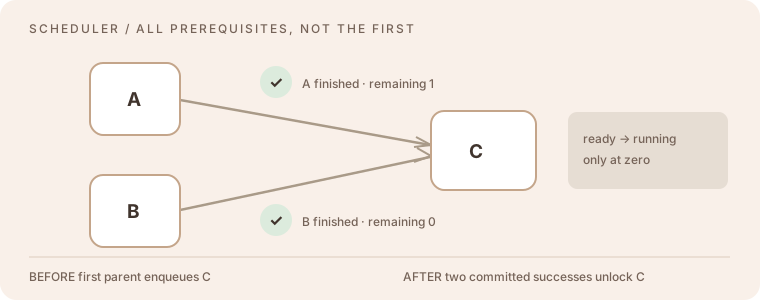
A→C, B→C; A finishes |
C still waiting |
All prerequisites, not any one |
B then finishes |
C becomes ready once |
Concurrent completion race |
A→B→A |
Reject before running | Cycle |
A→C; A fails |
C=blocked |
Failure propagation |
Duplicate completion event for A |
No second enqueue | Idempotency |
| No tasks | Empty result | Empty graph |
Think in public: indegree per task and reverse adjacency. Enqueue indegree-zero tasks; on a committed success, decrement each child once; move a child to ready exactly at zero. Topological precheck rejects cycles in O(V+E), with O(V+E) space. For concurrency, protect transitions (waiting→ready→running→succeeded/failed) atomically and bind completions to attempt IDs.

Before / after: the animation contrasts enqueueing C when the first parent finishes with counting down both prerequisites. The box diagram adds the durable boundary a thread-only solution lacks.

Follow-up 1 (senior): “A worker crashes after side effects but before reporting success.” Use attempt IDs for execution ownership and a stable logical-operation key for idempotent downstream effects; distinguish at-least-once execution from exactly-once business outcome. Follow-up 2 (staff): “The platform serves hundreds of tenants.” Add fair scheduling, tenant quotas, per-region recovery, dead-letter policy, lag metrics, and a bounded graph-size contract. Explain how you migrate scheduler state while work is running.
Worked extension: recover ownership without repeating a business effect
Give each attempt its own ID, but keep a stable logical operation key for a downstream effect that must not repeat across attempts. A new attempt ID used as a new payment key would permit a second payment. Reject completions from stale attempts at the authoritative state transition. Update task success and dependent readiness atomically, or persist enough event identity to replay the transition without decrementing a child twice.

For multiple tenants, bound each tenant’s ready and running work and decide how shared capacity is allocated. A graph-size cap also bounds scheduler metadata. Regional recovery must preserve the current write authority and accepted tasks, not only reconstruct a queue from process memory.
Debrief · what a strong answer contains
Draw the DAG and state transitions before threading. Name cycle detection, shared-state synchronization, duplicate completion, and crash replay. On bookshop design, distinguish inventory reservation from charge; show payment idempotency and compensating outcomes rather than a single database box labeled “transaction.”
Evidence: Interview Query's anonymized report (edited candidate summary, Q3 2026; not independently verified) and official product context. Other drills and architecture extensions are original practice, checked 22 September 2026.