Design a private asynchronous export service
A customer wants a downloadable file containing their own saved bookmarks. Building the file can take longer than one HTTP request may wait. Design how the service accepts the request, exposes progress, and later authorizes the download. The session is a design assignment, not a supplied export application.
“Customers export their private bookmark libraries as downloadable files. Today a request stays open until the file is ready and times out after 30 seconds. Design an asynchronous flow that reports progress and never serves another owner's file. Which promises should the API make when the caller disconnects?”
Constructed 50-minute design session. Prerequisites: architecture concepts and queue delivery, studied before session day. This is a build/design brief, not a claim of a supplied export application.
| Contract | Expected starting behavior |
|---|---|
| Load | 20 export starts/second; average file build 10 seconds; 10 MB typical file |
| Example | POST export → 202 plus job ID; GET job → queued/running/ready/failed |
| Durability | Acknowledged request can be found after client reconnect |
| Ownership | Only the authenticated owner can inspect job or download the artifact |
| Boundary | Duplicate start with the same request identity follows a declared policy |
| Excluded | Global active-active, paid billing and exactly-once email |
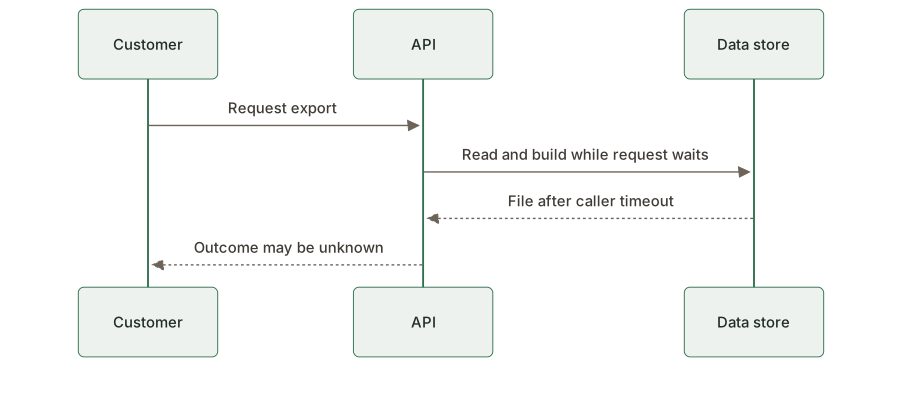
Restate the user-visible contract and assumptions, calculate a toy concurrency/storage budget, draw baseline state ownership, and trace success plus one crash. Then replace the boundary causing timeout; show durable acceptance, work ownership, status and authorization. Expected baseline reasoning: 20/s × 10s implies roughly 200 concurrent builds at that sustained arrival rate before accounting for variance/headroom; this is not an instruction to open 200 database connections.

At minute 20 the assessor supplies a failure trace; at minute 35 the requirement changes across teams. Ask questions before adding services. Provide schema/key choices, a state transition condition, rejected alternative and recovery test. Senior scope is a coherent critical path with failure/authorization semantics. Lead scope retains that floor and adds interface owners, rollout sequence, compatibility and measurable completion criteria.