Build a bookmark editor that preserves typing during a save
Alice edits the title of an existing bookmark. A submitted title and the text she is currently typing can differ while a request is pending. Build or repair the browser/API/database path so the successful old response confirms only the submitted value and preserves her newer draft.
“Alice edits a private bookmark title. Save is slow and she continues typing. The response overwrites her new text. Build or repair this vertical slice and show the browser behavior, the HTTP contract and the actual stored row.”
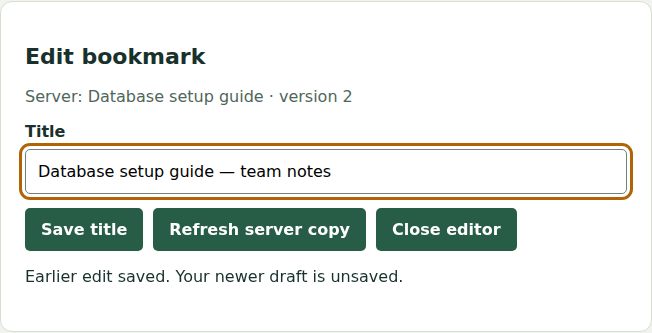
This screenshot shows the required distinction, not a mandatory visual design. Your implementation may use a different layout while preserving the same behavior.
Constructed 90-minute product session. During an independent build use a blank local workspace with HTML/TypeScript, a local HTTP server and SQLite; do not inspect the reference application or its tests. For a repair diagnostic, the assessor supplies a copy with one guard removed and records which file was changed. Framework choice is flexible; the repository supplies one executable reference after the attempt. No cloud deployment is required.
| Contract | Expected example |
|---|---|
| Editor | Draft is local; confirmed record has server version |
| Save | PATCH b {title:A,expectedVersion:1} with mutation key → A/v2 |
| In-flight edit | Type B before that response → input stays B, confirmed becomes A/v2 |
| Ownership | Alice cannot read/write Bob's row; enforce at server boundary |
| Pagination | Descending timestamp/id with tied timestamps; no skipped equal-time rows |
| UX | Loading, empty, error, retry, named keyboard controls and conflict feedback |
| Excluded | Production login, offline queue, create/delete and enrichment |
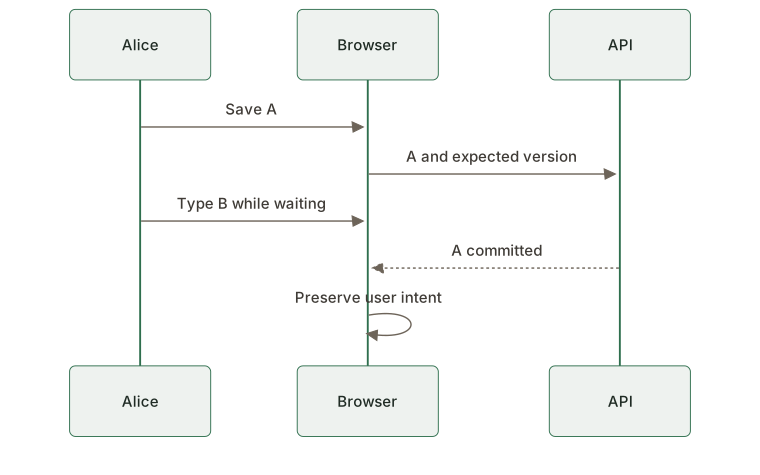
Start with a tiny fixture and draw state ownership. Trace one interleaving before coding, derive the server conditional write, and test the browser using controlled response completion. Name each state separately: draft/local revision, confirmed record, pending mutation snapshot and view/request generation. Expected baseline: only the sent snapshot is acknowledged; unsaved B cannot be labelled “saved.”

The assessor introduces two delayed or conflicting schedules. Explain what remains uncertain after a transport failure, and demonstrate the error/conflict recovery by keyboard. Show one real query measurement before proposing an optimization. Senior scope is a tested vertical path; lead scope adds old-client compatibility, observability and ownership. Study the prerequisite search race before session day, then debrief against the separate assessor sheet.