Choose the scope that removes repeated engineering work
Three teams consume order events from the same producer. One expects an amount in cents, another expects decimal dollars, and a third still reads an old field name. Engineers spend time repairing failures after each producer change. You can keep patching each consumer or introduce a shared versioned contract.
You will compare the local repair with the broader intervention, including migration and support work. “Scope” means the boundary of the problem you take responsibility for. A larger boundary is useful only when its benefit justifies its cost.
Project connection · feeds Reading-list stage 5: evolve the running application
Make the repeated incompatibility visible
| Consumer | Current expectation | Event arriving today |
|---|---|---|
| A | amount_minor: 1999, currency USD |
Field missing |
| B | amount_decimal: "19.99", currency USD |
Compatible |
| C | total: 1999 with undocumented units |
Meaning ambiguous |
The shared intervention might define one versioned producer envelope and owned adapters for A and C. It should not force unrelated domain calculations into one central service. Deliver one example event, the three adaptation decisions and an estimate of maintenance work removed versus work introduced. The arithmetic below uses constructed team-day estimates, not a claim about universal platform savings.
Reason through the changed situation
“Three teams each spend a day a week repairing incompatible event payloads. You can fix this week's failures or propose a shared contract. How do you decide whether the broader intervention is worth its cost?”
Scope is the boundary of the problem you own. Broader scope helps only if it changes a repeated outcome; creating a platform is not automatically leverage.
| Constructed input | What to establish |
|---|---|
| Three teams, one day/week each on repair | Verify the baseline and causes |
| Proposal costs six team-days initially | Include maintenance and migration work |
| Teams deploy independently | Define backward compatibility and ownership |
| One consumer cannot migrate this quarter | Preserve a supported bridge or narrow scope |

Decide where to intervene
- Inspect examples of actual repair work. If causes differ, one abstraction may hide incompatible requirements rather than remove repetition.
- Define a small shared contract and a versioning rule; retain domain-specific behavior with its owner.
- Test hard consumer requirements early in a replay or controlled pilot. Choose live exposure with bounded impact; measure repair hours and adoption effort.
- Assign ownership, support boundaries, and a stop condition. A shared service without an owner can become a new bottleneck.
“The pilot helps two teams but slows the third.” Draw the allowed exception and the evidence that would justify convergence later.

Senior evidence is a sound implementation and measured local result. Lead/staff evidence adds an agreed cross-team decision, adoption, and sustained outcomes. A solo exercise practices the reasoning; it cannot manufacture that history.
Match scope to the problem
Company ladders and staff titles differ. This guide uses senior, lead and staff follow-ups to practice increasing ambiguity, coordination and ownership; they are not universal promotion criteria. Deep specialist work, sustained technical leadership and cross-team coordination can all matter. Coding quality does not cease to matter when a title changes.
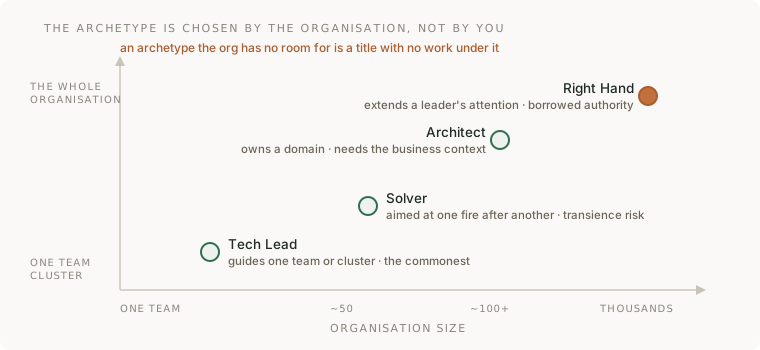
Treat the pictured archetypes as prompts for understanding a role, not a ranking or a requirement to become all four. Verify the actual mandate, authority and success measures of a role instead of inferring them from company size.
Count the benefit and the work it creates
In the constructed three-team example above, compatibility repair consumes three team-days per week. A shared contract costs six team-days to introduce. If it removes two repair days per week and adds half a day of weekly support, the net saving is 1.5 team-days/week; the initial effort breaks even after four weeks, before any additional migration or coordination cost.
This is a prediction to test, not a guaranteed platform return. The third team may have a legitimate different requirement. Preserve an owned exception when forcing convergence would cost more than it saves.
| Evidence | What it supports | What it does not prove |
|---|---|---|
| Fewer repair hours under comparable work | A useful local outcome | Universal staff readiness |
| Another team adopts and independently operates the contract | Adoption and reduced dependence | That every team should use it |
| A solo reference implementation passes tests | Reference correctness under those cases | Real cross-team leadership history |
Mentorship and sponsorship are different contributions
Mentorship develops another person's capability through teaching, feedback or practice. Sponsorship advocates for their access to an opportunity. Neither is automatically cheap, effective or superior. Evaluate actual outcomes, time, access and attribution. Successful mentoring need not produce a promotion story.
Coordination and maintenance are work too. Record who did them and who benefits; do not claim a teammate's independent result as your own output.
Practice on P5
Name a structural problem, verify examples, and compare a local fix with a broader intervention. Include adoption, support and transition costs. Choose the smallest scope that addresses the cause and identify what would reverse that choice. A small well-targeted change can be more useful than a platform.
Acceptance: another reader can explain the problem, proposed boundary, trade-off, owner and measure of success. They may approve unchanged. An exercise can test that reasoning but cannot manufacture employment history or predict a hiring outcome.
Write a design document that supports a decision · Engineering effectiveness
Draw it from memory · Show who owns the shared constraint

Replace “build a platform” with the smallest shared constraint and an adoption measure.