Require exact human approval before agent actions
Application background
A support assistant suggests giving a customer a $5 credit for a particular ticket. That suggestion appears for a human reviewer to inspect. Only after the reviewer approves the exact action should a separate executor contact the payment provider.
An approval is not general permission to do whatever the assistant later suggests. If the amount changes to $50, the target changes or the approval becomes too old, the original click no longer authorizes the operation.
The proposed action the reviewer sees
This is an illustrative proposal record, not the complete stored schema of the supplied workflow:
{"proposal_id":"p-7","version":1,"ticket_id":"T7","action":"credit","amount_minor":500,"currency":"USD"}
500 is five dollars expressed in cents. The approval must identify this proposal version and these effectful fields. Changing amount_minor to 5000 changes the proposed action to fifty dollars and requires new approval.
The executor is the component allowed to perform the external action. It must verify the saved approval and current facts before using provider credentials.
Your assignment
Deliver: Extend the supplied proposal and approval workflow with a reviewer interface. Handle changed parameters, expired approvals and uncertain provider outcomes before connecting real actions.
Required behavior: Proposal, approval and execution are separate durable states. Approval identifies the exact target and the same consistently represented parameters that execution will use. Different amounts or targets need different approval. The executor rechecks permission, expiry and operation identity before performing an external effect.
The required first milestone is a working local implementation of the behavior above. The numbered implementation steps define the scope. The cloud architecture is a later extension, not something the starter has already provisioned.
Get the code and run the supplied example
The code is in the public junior-to-staff repository. Install Git and Python 3.12+. No AWS account or Python packages are required for this first run. If you already have a checkout, use it and skip cloning.
git clone https://github.com/Soulful-Iris/junior-to-staff.git
cd junior-to-staff
python3 examples/ai-systems/demo.py agent
Supplied code: AI workflow implementation, starting at demo.py. These are local workflows with fixture providers and temporary storage. They do not include the user interface or connect to the AWS services in the diagram.
Example output from the supplied run:
Generated IDs and timestamps may differ. Compare the state transitions and outcomes.
[
  {
    "request": {
      "action": "order.put",
… (more output follows)
Set up your implementation workspace
Create work/02-approval-desk/ in your checkout (or use a separate repository). Copy examples/ai-systems/ there so you can change the workflow and its storage/provider boundaries together. The record and module names below describe what you must implement. They are not a promise that files with those names already exist. Keep a README.md beside your implementation with its exact run commands and observed results.
Local components and state to implement
This table names the records, interfaces or decision inputs for your deliverable. Unless a name is explicitly linked to supplied source above, it is something you create. Implement the local state transitions first, then connect the HTTP, storage or worker boundaries required by the steps.
| Record / module | Key or interface | Responsibility |
|---|---|---|
| proposal | id,type,target,parameters_hash,version | Exact action awaiting human review. |
| approval | proposal_version,approver,expires_at | Bounded authorization, not general tool access. |
| execution | operation_id,provider_key,outcome | One logical effect with retry/reconciliation evidence. |
Implement the assignment
1. Run the proposal-to-execution reference
Execute the agent demo, inspect the immutable proposal and approval receipt, and identify the executor boundary in the retained implementation. The supplied demo shows approval and duplicate execution handling. Add changed-parameter and expired-approval cases as explicit next implementation steps before connecting a real provider.
2. Build the reviewer interface
Show target, amount, currency and effect in plain language. Keep approval attached to a proposal version/hash. Editing any effectful parameter creates a new proposal. The UI cannot silently reuse a previous click.
3. Add a restricted executor
Give it only the approved action types and provider credentials. Revalidate current reviewer/subject authority, expiry and source facts. Persist a stable provider key before the call and classify timeout as unknown rather than definitely not executed.
4. Reconcile external outcomes
Query or safely retry under the provider’s actual idempotency contract. Preserve attempt history and show pending repair to the operator. A model-generated explanation is not evidence that a credit happened.
Demonstrate the completed local result
| Action | Expected visible result |
|---|---|
| Run the existing agent demo | Follow proposal, approval and execution evidence through the local workflow. |
| Change amount after approval | Execution refuses the stale approval. |
| Lose the provider response | The operation remains unknown until reconciled using the original identity. |
Handoff: In your implementation README, include the start command, one successful operation, the failure case above and the resulting stored state or decision. State which dependencies are simulated. Someone with a fresh checkout should be able to reproduce this without your chat history.
Workload assumptions and capacity decisions
These are constructed exercise assumptions. The stated workload is a design target. The local demonstration does not establish that throughput. Use the estimation constants to check units before choosing capacity.
| Input or objective | Calculation / consequence |
|---|---|
| 500 proposed actions/day assumption | A small ledger can provide complete proposal/approval history. Scale is not a reason to omit it. |
| Ten-minute approval lifetime | Expiry is checked at execution, even if the queued action was approved earlier. |
| 1% ambiguous provider responses | Five cases/day require reconciliation at the stated volume. Unknown is a first-class outcome. |
Map the local implementation to AWS
Deployment status: local only. Running the supplied command creates no AWS resources and configures no cloud connections. The diagram is a proposed deployment of the completed application. Each box needs either a deployed runtime, a provisioned service or an explicitly external dependency.
Read the diagram by following the arrows from the entry point: application code accepts the request or event, the state owner commits it, and any worker produces the later result. The table ties those roles to code and adapter work. Multiple boxes do not imply multiple Python files already exist.
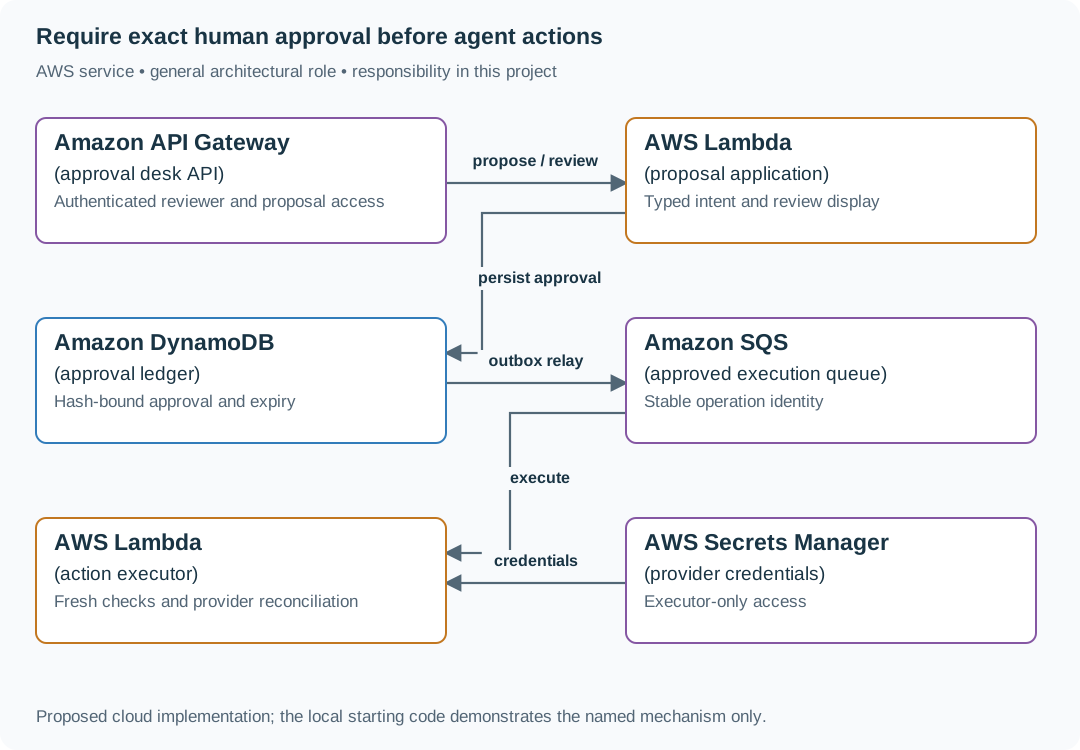
The durable approval ledger and restricted executor enforce authority. A queue moves approved work but does not make stale or changed proposals valid.
| Local responsibility | Cloud destination and role | Implementation still required |
|---|---|---|
| Local HTTP boundary or the endpoint you will add | Amazon API Gateway: approval desk API | Create routes and an integration. Translate requests and responses and configure identity validation. |
| Python operation or worker function | AWS Lambda: proposal application | Write a Lambda event adapter, package its dependencies and give its role only the required resource actions. |
| Local dictionary, SQLite records or state model | Amazon DynamoDB: approval ledger | Design partition/sort keys and write a storage adapter with conditional updates or transactions. Python state and SQL are not uploaded as a database. |
| Local pending-work collection | Amazon SQS: approved execution queue | Publish committed job intent, consume messages and persist deduplication/ownership state. Add visibility, retry and dead-letter handling. |
| Python operation or worker function | AWS Lambda: action executor | Write a Lambda event adapter, package its dependencies and give its role only the required resource actions. |
| Local provider configuration placeholder | AWS Secrets Manager: provider credentials | Store provider credentials, scope runtime reads and implement rotation without writing secrets to logs. |
Provision resources, then connect the application
| Resource or boundary | Initial configuration and reason |
|---|---|
| Roles | Proposal generation cannot call effectful providers. Execution credentials are isolated. |
| Ledger | Conditional state transitions and durable operation identity. Queue duplication cannot create fresh authority. |
| Provider adapter | Document idempotency retention, lookup support and unknown-outcome repair before using real effects. |
Use one disposable AWS environment for the cloud exercise. Put the named resources in infra/template.yaml or your existing IaC tool, pass resource IDs through configuration, and scope each runtime role to its own tables, buckets and queues. The diagram is a design to implement. It is not a claim that these resources have been deployed. Record the commands you used to deploy and remove the exercise resources.
For concrete provisioning commands, configuration wiring and cleanup, use the AWS foundation guide. It includes a deployable table/queue/object-storage foundation and explains which application and service adapters you still implement.
A provisioned queue or table does not make the local program use it. Configure resource IDs in the deployed runtime, replace the local adapter, and replay the same successful and failing operation against that runtime. Record the deployed commit and observable result, then remove the disposable resources using your infrastructure tool.
Extend the design after the baseline works
Worked follow-up: Turn an approved batch into individually accountable effects
Approval of ten credits must not become permission for an eleventh. A crash after credit three also must not cause credits one through three to be submitted with new identities.
| Starting design | Changed requirement |
|---|---|
| One approved proposal produces one local receipt. | A batch can partly execute against a real provider before the process stops. |
Revised architecture. Follow the changed responsibility and failure path below. This is a design to implement. The supplied local example does not provision these components.

What to implement. Hash the complete approved item set, per-item amounts, currencies and aggregate limits. Persist a batch record and a stable provider operation ID for every item. Execute only items covered by a still-valid approval and recheck limits before each effect. Keep confirmed, unknown and not-started states separately. An uncertain item is reconciled with its original provider before automatic continuation or retry. A reviewer sees partial completion rather than one misleading batch-failed label.
Walk through the result. Approve three credits of $5. Confirm item 1, lose the response for item 2 and stop before item 3. Restart and recover item 2 by its original identity. Add a fourth item and show rejection because the plan hash changed. Deliver the batch approval and three-item outcome ledger.
Approve a batch of credits. Bind approval to the complete item set and per-item limits, then report partial execution and repair without turning one approval into an unlimited batch capability.
Additional design cases, alternatives and original source notes
The reviewer's brief
“Support staff spend time turning customer messages into refund requests. Build an AI assistant that proposes the refund amount, shows the operator exactly what would happen, and records one approved result even if the operator retries. Customers sometimes ask for more than they paid. The model sometimes invents a tool.”
End product: a working proposal/approval workflow backed by a durable sandbox refund ledger. It parses customer messages with a model, validates the action in code, persists a proposal, binds approval to its digest, and atomically updates the order and receipt. It does not move real money. Adding a payment provider is an explicit follow-up with different failure behavior.
Define the actual problem
The model is allowed to propose one operation: refund. A proposal must contain an integer amount in cents, within 1..100,000, and no more than the remaining paid balance. It expires after 15 minutes. Orders support up to 20 proposal records in this bounded implementation. Separate invocations create and approve a proposal. The model has no path to call the approval handler.
01 · Normal proposal
- Input / starting state
- Order paid 5,000 cents. Message
Please refund USD 12.50 - Expected result
PENDING_APPROVAL, amount 1,250 cents. Balance still unchanged
02 · First approval
- Input / starting state
- Operator submits the stored proposal digest before expiry
- Expected result
COMMITTED, one receipt, refunded balance becomes 1,250
03 · Retry
- Input / starting state
- Repeat the exact approval request
- Expected result
- Same receipt. Refunded balance remains 1,250
04 · Changed request
- Input / starting state
- Reuse
ticket-1with messagePlease refund USD 1.00 - Expected result
- Conflict. Do not reinterpret an existing request ID
05 · Wrong digest
- Input / starting state
- Approve a digest other than the stored proposal's
- Expected result
- Reject. No balance change
06 · Expiry
- Input / starting state
- Approve at or after the proposal's expiry timestamp
- Expected result
- Reject. Create a fresh request after review
07 · Competing refunds
- Input / starting state
- Two pending 1,250-cent proposals against a 2,000-cent order
- Expected result
- First may commit. Second fails the fresh balance check
08 · Invented capability
- Input / starting state
- Model returns tool
shellor amounttrue - Expected result
- Reject. Only the recognized tool and integer money contract pass
Why proposal and execution are separate
A tool proposal is untrusted structured data. An approval is an operator decision bound to exact data. A receipt is evidence of a committed state transition. An attractive explanation from a model is none of these authorities.
The proposal digest covers order ID, request ID, amount, policy version, and expiry. Showing “approve refund” without these values would let the operator approve an ambiguous action. A changed amount requires a new digest and a new review.
Draw the AWS architecture
| AWS service / general role | Responsibility | Alternative and why |
|---|---|---|
| Amazon Bedrock / proposal inference | Translate a customer message to candidate tool and amount | Deterministic form entry is better when the message already has structured fields |
| AWS Lambda / application policy and action handler | Validate tool, money, proposal expiry, digest, and balance | ECS when integrating long-lived agent sessions or streaming tools |
| Amazon DynamoDB / order and approval state | One conditional write commits sandbox balance and receipt together | Aurora transaction if real order state already lives in SQL |
| AWS IAM / operator invocation boundary | Only authorized sandbox operators invoke the Lambda | Cognito/OIDC plus application roles for a real user-facing product |
| AWS Step Functions Standard / durable workflow | Extension for timers, multi-stage human approval, and reconciliation | Keep direct state transitions for this bounded two-stage flow |
Implement the whole workflow
- Create the sandbox order. Store
paid_cents, zero refunded balance, and an empty proposal collection. An existing order ID cannot be overwritten by another create. - Handle request identity. A repeat request ID with the same message returns the saved proposal. The same ID with a changed message conflicts.
- Ask the model. Request JSON with tool and amount. It receives the customer message but no AWS credential, arbitrary tool registry, or approval capability.
- Apply policy. Reject unknown tools, floats, booleans masquerading as integers, nonpositive amounts, and amounts beyond the order balance.
- Save for review. Persist the exact action, policy version, expiry and digest. No ledger effect happens yet.
- Approve separately. The operator submits order ID, request ID and digest. The handler rereads state, verifies expiry and current balance, then conditionally writes the new balance and receipt.
- Recover a lost response. Retry the same approval. If it already committed, return its existing receipt. If a competing write caused a conflict, reload and re-evaluate.
if proposal["status"] == "COMMITTED":
    return proposal  # The prior receipt is the retry result.
if now >= proposal["expires_at"]:
    raise Invalid("proposal expired")
The actual handler checks the digest before this branch and current balance before committing. Read agent_propose and agent_approve in the supplied application to follow the complete order of checks.
Run it
python3.12 examples/ai-systems/demo.py agent
The session creates a USD 50.00 order, proposes USD 12.50, approves, and repeats approval. Compare the two receipt fields: they must match. Inspect the tests for expiry, stale writes, changed message IDs, competing proposals, and invented tools. On AWS run cloud_smoke.py agent --function "$AI_FUNCTION" from the workbench directory.
Follow-up: connect a real payment provider
The sandbox's balance and receipt fit in one database update. A remote payment call cannot join that transaction. If the provider charges/refunds and the response is lost, a local timeout does not mean the payment failed.
Senior follow-up: add APPROVED → SUBMITTED → CONFIRMED / UNKNOWN states. Persist a stable provider idempotency key before submission. On timeout, query/reconcile that key. Do not generate a fresh refund ID. Record the provider receipt separately from the model proposal.
Staff follow-up: add independent approver roles, limits by region, policy version migrations, and emergency revocation. The same person may not be allowed to propose and approve. Split handlers and IAM permissions or add a verified application authorization service. The current sandbox operator has both capabilities by design.
Engineer FAQs
Is the digest a password? No. It identifies the reviewed action. An attacker with approval authority and the digest could still approve. Authentication and authorization remain separate requirements.
Why store expiry instead of just a DynamoDB TTL? TTL deletion is asynchronous. The application must compare the deadline when approving. A retained expired record also explains why an old request was rejected.
Can the model approve its own proposal? The supplied model adapter only returns JSON. It has no tool execution loop, network credentials, or route to invoke agent.approve.
Why integer cents? Decimal currency should not depend on binary floating-point arithmetic. Currency scale and supported currencies must be part of the contract. This project supports USD only.
What does “once” actually mean? At most one committed sandbox ledger effect for this request, because the receipt and amount are one conditional record update. Model inference may repeat after an interrupted proposal attempt. A real provider needs its own idempotency contract.
Would Step Functions remove the need for request IDs? No. Workflow durability and remote side-effect idempotency solve different problems. Human callbacks also need expiry and a secure mechanism for resolving the correct pending action.
What happens if two operators approve together? One conditional write succeeds. The other gets a conflict, reloads state, and can retrieve the same receipt. Blindly retrying the stale write is incorrect.
What you are expected to hand over
Bring a pending proposal with the exact amount, a committed receipt, a duplicate approval trace, and the competing-refund test. Include the difference between sandbox atomicity and external-provider reconciliation, plus the IAM/application role split for a product deployment.
How the review conversation gets harder
| Review gate | Changed requirement | Evidence to bring |
|---|---|---|
| Baseline | USD 12.50 refund on a USD 50 order | Proposal, approval, one receipt |
| Failure | Reply to approval is lost | Retry returns the saved receipt |
| Senior | Payment provider accepts then times out | UNKNOWN state, stable key and reconciliation |
| Staff | Requester cannot also approve | Separate verified capabilities and auditable decision |
| Evidence | Model proposes a shell command | Recognized-tool validation rejects it before effects |
| Handoff | Original operator is unavailable | Durable pending action, expiry rules and recovery instructions |
Research behind the design
Reviewed September 23, 2026. The AWS human approval tutorial demonstrates a paused workflow and an external approval. Conditional writes supply the version guard used here. Amazon's February 2026 agent evaluation report discusses evaluating tool choice and recovery as well as final answers. The sandbox ledger and its exact policy limits are original reference code.