Two pointers: discard work with a reason
You have sorted prices and want to know whether two different items total a budget. Trying every pair repeats work. Start at the cheapest and most expensive remaining prices, then justify which end you can discard after each comparison. The ordering assumption is part of the algorithm, not a cosmetic detail.
Two pointers track boundaries or positions while traversing a sequence. The important part is the proof that moving one pointer cannot skip an answer. Sorting often supplies that proof; without order, the same movement may be invalid.
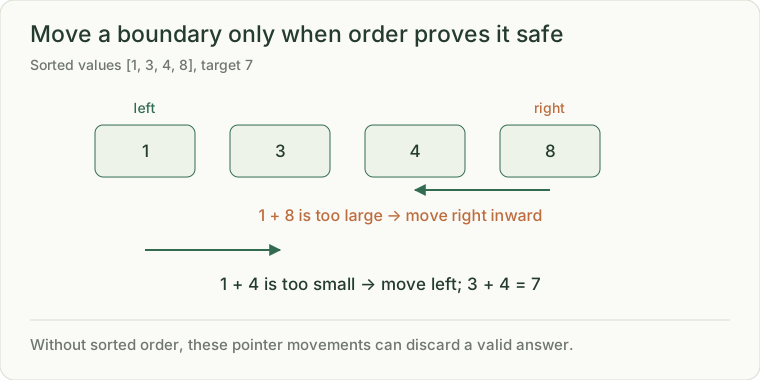
Opposite ends of sorted data
def contains_pair(values, target):
    left, right = 0, len(values) - 1
    while left < right:
        total = values[left] + values[right]
        if total == target:
            return True
        if total < target:
            left += 1
        else:
            right -= 1
    return False
This snippet assumes ascending values. On [1, 3, 4, 8], target 7, 1+8 is too large, so moving right inward is safe: pairing 8 with any larger left value would only increase the sum. Then 1+4 is too small, so move left inward; 3+4 succeeds.
It visits at most n pointer positions: O(n) time and O(1) extra space. Sorting an arbitrary input first adds O(n log n) work and can lose original indices unless they are retained. A two-sum contract requiring original positions therefore needs that extra design decision.
Related movement patterns
| Pattern | What the positions mean | Safety condition |
|---|---|---|
| Opposite ends | Remaining candidate range | Order proves which side can be discarded |
| Read/write | Scanned prefix and compacted result | Writing never destroys unread data |
| Fast/slow | Different speeds through links | Identity and termination are handled |
| Sliding window | Current contiguous range | Its validity can be updated as boundaries move |
For [3], left < right is false, so one position cannot count twice. For unsorted [3,1,4], do not assume the same sum comparisons justify pointer movement. State the precondition before using the technique.
Explain every discarded pair
For [1, 3, 4, 8] and target 7:
| Left value | Right value | Sum | Why movement is safe |
|---|---|---|---|
| 1 | 8 | 9 | Even the smallest remaining partner makes 8 too large. Discard 8 |
| 1 | 4 | 5 | Even the largest remaining partner makes 1 too small. Discard 1 |
| 3 | 4 | 7 | Found two distinct positions |
If the input is unsorted, those statements are no longer justified. Sorting first may be acceptable, but retaining original positions or preserving input order becomes an additional responsibility.