Build versioned API routing and admission policies
Application background
Many internal teams expose HTTP APIs, and clients need a common address to reach them. An API gateway receives a request, checks shared entry rules and forwards it to the selected service. For example, /orders/17 goes to the order service.
The gateway needs a table of routes and configuration versions. A bad update could otherwise break many services at once. Verifying a caller's identity at the gateway also does not decide which individual orders that caller may read.
Example walkthrough
01 · Try this input
- Input / starting state
- A client requests
/orders/17 - Expected result
- Forward it to the configured order service.
02 · Try this input
- Input / starting state
- A route update names an invalid destination
- Expected result
- Refuse to activate that configuration.
03 · Try this input
- Input / starting state
- A caller requests another customer's order
- Expected result
- Let the order service enforce ownership even after gateway authentication.
Authentication establishes who the caller is. Resource authorization decides whether that caller may perform this operation on this particular record.
Your assignment
Deliver: Build a versioned route configuration with validation, activation and rollback. Trace one request to show what the gateway checks and what the destination service still decides.
Required behavior: The gateway verifies identity and routes using a versioned configuration snapshot. Backends authorize requested objects. The gateway adds at most 15 ms p99 overhead under the stated load and propagates a request deadline and trace context.
The required first milestone is a working local implementation of the behavior above. The numbered implementation steps define the scope. The cloud architecture is a later extension, not something the starter has already provisioned.
Get the code and run the supplied example
The code is in the public junior-to-staff repository. Install Git and Python 3.12+. No AWS account or Python packages are required for this first run. If you already have a checkout, use it and skip cloning.
git clone https://github.com/Soulful-Iris/junior-to-staff.git
cd junior-to-staff
python3 examples/architecture-starts/api_gateway_platform.py
Supplied file: examples/architecture-starts/api_gateway_platform.py. You can also read or download the source here (download file, source below).
Read the supplied code · api_gateway_platform.py
"""Local mechanism demonstration for api-gateway-platform. No AWS resources are created."""
active={'version':1,'routes':{'/orders':'orders-v1'}}
def activate(candidate):
    if not candidate.get('routes') or any(not p.startswith('/') for p in candidate['routes']): return 'rejected; keep version '+str(active['version'])
    active.clear(); active.update(candidate); return 'active version '+str(active['version'])
print(activate({'version':2,'routes':{'orders':'broken'}}))
print(activate({'version':3,'routes':{'/orders':'orders-v2'}}))
print(active)
This program is a mechanism demonstration: it runs the small scenario in one process and prints the result. It is not an HTTP service, a complete application, or an AWS deployment. A successful run demonstrates this mechanism only. It does not establish the workload or failure guarantees of the application you will build.
Example output from the supplied run:
Generated IDs and timestamps may differ. Compare the state transitions and outcomes.
rejected; keep version 1
active version 3
{'version': 3, 'routes': {'/orders': 'orders-v2'}}
Set up your implementation workspace
Create work/api-gateway-platform/ in your checkout (or use a separate repository). Copy the supplied mechanism into that directory as mechanism.py, then extract its state transitions into functions you can call from your implementation. The record and module names below describe what you must implement. They are not a promise that files with those names already exist. Keep a README.md beside your implementation with its exact run commands and observed results.
Local components and state to implement
This table names the records, interfaces or decision inputs for your deliverable. Unless a name is explicitly linked to supplied source above, it is something you create. Implement the local state transitions first, then connect the HTTP, storage or worker boundaries required by the steps.
| Record / module | Key or interface | Responsibility |
|---|---|---|
| route_config | version,route,upstream,timeout,auth_policy | Validated immutable snapshot with rollback pointer. |
| request_context | subject,claims,deadline,trace_id | Trusted metadata passed through a protected backend boundary. |
| config_status | instance_id,applied_version,error | Evidence of rollout convergence and failed adoption. |
Implement the assignment
1. Implement one protected route
Validate issuer, audience, signature and token expiry. Strip untrusted identity headers before adding trusted context. Protect the gateway-to-backend network/authentication boundary so a caller cannot bypass the gateway and forge context.
2. Bound each request
Propagate an absolute remaining deadline and use bounded connections, body sizes and queueing. Do not retry non-idempotent backend operations merely because the gateway timed out. Measure authentication, routing and upstream waiting separately.
3. Ship configuration as an atomic snapshot
Validate routes, auth rules and timeout bounds before activation. A custom proxy can consume AppConfig. AppConfig does not automatically reprogram API Gateway. Instances retain the last valid snapshot on parse failure and report the exact applied version.
4. Roll out by limited traffic scope
Start with a subset of instances or routes, compare errors/latency, and restore the prior snapshot on an observed regression. Keep configuration change ownership and emergency access explicit without moving object authorization into a universal gateway rule.
Demonstrate the completed local result
01 · Try this input
- Input / starting state
- Run the starting program
- Expected result
- Invalid configuration leaves version 1 active. Valid version 3 activates atomically.
02 · Try this input
- Input / starting state
- Forge a subject header
- Expected result
- The gateway discards it and the backend receives only verified context.
03 · Try this input
- Input / starting state
- Slow one upstream
- Expected result
- Its bounded pool saturates without exhausting unrelated service routes.
Handoff: In your implementation README, include the start command, one successful operation, the failure case above and the resulting stored state or decision. State which dependencies are simulated. Someone with a fresh checkout should be able to reproduce this without your chat history.
Workload assumptions and capacity decisions
These are constructed exercise assumptions. The stated workload is a design target. The local demonstration does not establish that throughput. Use the estimation constants to check units before choosing capacity.
| Input or objective | Calculation / consequence |
|---|---|
| 25,000 requests/s across 150 services | Mean per service is about 167/s, but hot routes must be sized separately. |
| 15 ms p99 added overhead | Measure gateway time independently of backend latency and client network time. |
| Configuration rollout to 100 instances assumption | Track applied version and rejection reason. A successful upload is not proof every instance activated it. |
Map the local implementation to AWS
Deployment status: local only. Running the supplied command creates no AWS resources and configures no cloud connections. The diagram is a proposed deployment of the completed application. Each box needs either a deployed runtime, a provisioned service or an explicitly external dependency.
Read the diagram by following the arrows from the entry point: application code accepts the request or event, the state owner commits it, and any worker produces the later result. The table ties those roles to code and adapter work. Multiple boxes do not imply multiple Python files already exist.
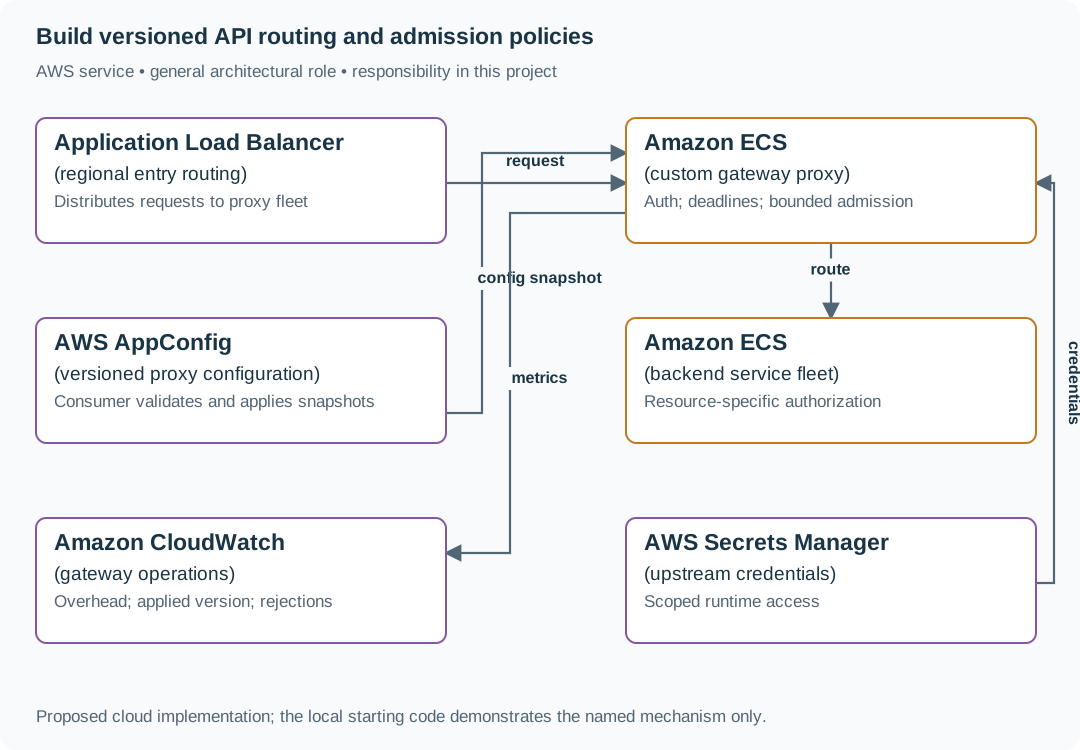
This is a custom proxy platform behind an ALB. Managed API Gateway is an alternative when its routing, authentication and quota features fit. Its control plane and deployment model are different from an AppConfig-driven proxy.
| Local responsibility | Cloud destination and role | Implementation still required |
|---|---|---|
| Local HTTP listener | Application Load Balancer: regional entry routing | Deploy a service behind a target group, configure health checks and bounded connection/request behavior. |
| Application or worker process | Amazon ECS: custom gateway proxy | Build a container and task definition. Supply configuration, task roles and graceful shutdown behavior. |
| Local versioned configuration | AWS AppConfig: versioned proxy configuration | Publish validated configuration versions and consume them with bounded caching and rollback behavior. |
| Application or worker process | Amazon ECS: backend service fleet | Build a container and task definition. Supply configuration, task roles and graceful shutdown behavior. |
| Local counters, timestamps and diagnostic output | Amazon CloudWatch: gateway operations | Emit bounded metrics and logs, build the named operational view and configure retention and access. |
| Local provider configuration placeholder | AWS Secrets Manager: upstream credentials | Store provider credentials, scope runtime reads and implement rotation without writing secrets to logs. |
Provision resources, then connect the application
| Resource or boundary | Initial configuration and reason |
|---|---|
| Gateway fleet | At least two AZs, bounded connection pools and graceful draining. Size from measured per-task capacity. |
| Configuration consumer | Poll/cache versioned snapshots with validation and a last-known-good fallback. Expose applied version. |
| Authentication | Pin trusted issuers/audiences, handle key rotation and define behavior when key refresh fails. |
Use one disposable AWS environment for the cloud exercise. Put the named resources in infra/template.yaml or your existing IaC tool, pass resource IDs through configuration, and scope each runtime role to its own tables, buckets and queues. The diagram is a design to implement. It is not a claim that these resources have been deployed. Record the commands you used to deploy and remove the exercise resources.
For concrete provisioning commands, configuration wiring and cleanup, use the AWS foundation guide. It includes a deployable table/queue/object-storage foundation and explains which application and service adapters you still implement.
A provisioned queue or table does not make the local program use it. Configure resource IDs in the deployed runtime, replace the local adapter, and replay the same successful and failing operation against that runtime. Record the deployed commit and observable result, then remove the disposable resources using your infrastructure tool.
Extend the design after the baseline works
Worked follow-up: Let teams own routes without editing the whole gateway
A typo in one team's route should not remove another team's checkout endpoint. Moving edits into a UI does not by itself reduce the blast radius.
| Starting design | Changed requirement |
|---|---|
| A central gateway loads one configuration. | Each team owns a namespace and can publish a scoped route revision. |
Revised architecture. Follow the changed responsibility and failure path below. This is a design to implement. The supplied local example does not provision these components.

What to implement. Separate the control plane, which accepts route changes, from the data plane, which serves requests. Validate ownership, route conflicts, target permissions and retry policy before producing an immutable configuration revision. Gateway instances acknowledge the revision they loaded and retain the last known good one if the control plane fails. Roll out by gateway cohort and keep old revision compatibility for in-flight requests. On AWS, an ECS gateway and a versioned configuration store can demonstrate this separation.
Walk through the result. Let team A change /a while team B serves /b. Submit a wildcard from A that would capture /b and show rejection. Then make A's accepted revision fail on a small cohort and restore the old revision without changing B's routes. Supply configuration IDs and per-route outcomes.
Offer team-managed routing. Define ownership namespaces, validation and blast-radius limits so a team can change its service without editing a global configuration file that can disable unrelated routes.
Additional design cases, alternatives and original source notes
This is a commonly listed system-design interview prompt with a concrete practice contract. Assume 25,000 requests/s, 150 services and gateway p99 overhead under 15 ms. Clarify service guarantees and a first version before filling the board with services.
01 · Try this input
- Input / starting state
- Unknown route
- Expected result
- Fail closed with a clear 404. Do not guess a backend.
Input / condition: Caller requests /v9/billing
02 · Try this input
- Input / starting state
- Auth expires
- Expected result
- Return 401 without forwarding. An already admitted request follows its deadline and backend policy.
Input / condition: Token expires before admission
03 · Try this input
- Input / starting state
- Bad config
- Expected result
- Validation blocks publish or staged rollout catches it.
Input / condition: New route points billing to staging
04 · Try this input
- Input / starting state
- Dependency slow
- Expected result
- Per-route deadline and circuit breaker protect unrelated APIs.
Input / condition: One service stalls 8 seconds
Think from the contract to the boxes
The gateway should centralize policy and routing, not domain business logic. Treat config as a versioned artifact: validate route targets, auth modes, timeout budgets, and compatibility before a canary. Keep each request’s end-to-end deadline. Retry only safe/idempotent operations and never beyond remaining time. Avoid becoming a global failure domain by isolating route/config caches and rollout.
Authorization boundary: validate issuer, audience, signature, expiry and required scope immediately before admission. Pass a trusted, request-bound identity to the backend. Each backend still checks resource ownership. In this baseline, expiry after admission does not revoke that request or undo a commit. A backend requiring a fresh check at commit must say so and reject before its effect. A 60-second reauthorization interval for long-lived streams is a separate policy, not a property of ordinary HTTP requests.
| Expiry trace | Result |
|---|---|
| Admission at 12:00:01. Token expired at 12:00:00 | 401. Nothing sent downstream. |
| Admission at 11:59:59. Expiry 12:00:00. Commit 12:00:01 | Accepted operation may complete under its original deadline. |
| Commit succeeded, response was lost, token now expired | Authenticate again. Replay the same operation key and recover the committed result. Do not turn credential refresh into a new charge. |
Route-control choice: API Gateway integrations are deployed through its configuration API/IaC. AppConfig does not directly rewrite those integrations. For a custom ALB/ECS proxy, an AppConfig client fetches a candidate route snapshot. The proxy validates destinations against an allowlist and atomically swaps an in-memory version. In-flight requests retain their selected route version. Keep the last known good snapshot on fetch/validation failure. Test a bad target and rollback without moving already-started requests.
First diagram: Draw config publish separately from request flow. Label the validation gate, per-route budget, auth decision, and backend health boundary.
| AWS service / general role | Why it fits this design | Alternative and when it fits better |
|---|---|---|
| Amazon API Gateway / managed API entry | Handle managed HTTP APIs and common auth/throttle policies. | ALB + ECS proxy for custom protocol transformations and high request control. |
| AWS Lambda / policy hook | Run short custom request validation. | ECS sidecar/plugin for low-latency stable policies. |
| Amazon Cognito / identity provider | Issue/verify user tokens for applicable products. | External OIDC provider when enterprise identity is already managed. |
| AWS AppConfig / route policy rollout | Distribute versioned policy to an explicit custom consumer. Not a direct API Gateway integration updater. | GitOps config distribution when team-owned proxy fleet is preferred. |
| Amazon CloudWatch / route telemetry | Measure per-route latency, errors and throttles. | Existing OpenTelemetry stack with per-route labels and alarm ownership. |
Service choice follows the contract: the box label gives the generic job, while the table explains the AWS product and a reasonable substitute. Name which component owns durable truth, where retries happen, and the guarantee each managed service does not provide by itself.
Pressure-test the design
Follow-up: A route rule is a production deploy. Trace old and new config through validation, canary traffic, alarm, rollback, and already-started requests.
A route has side effects and a timeout. Show why retry could duplicate work, how idempotency is exposed, and how retry budget prevents amplification.
Ten teams want incompatible gateway features. Set extension points, ownership and migration contracts while keeping the gateway’s failure modes bounded.
Practice artifact: Draw config publish separately from request flow. Label the validation gate, per-route budget, auth decision, and backend health boundary. Then trace every row in the table, draw one failure, and state what the customer observes. Suggested rehearsal: 35 minutes design, 10 minutes to challenge the guarantees.
Evidence and origin: The current community interview-question catalog lists an API gateway platform prompt at MongoDB. It does not publish when that report occurred. The entry does not show the interview date and is not a verified company rubric. The prompt contract, workload, outcomes, diagrams and solution here are original practice material. Treat company tags as reported sightings, not a prediction of your interview loop.
Interview report listing: Open the community question entry.