Linked lists: preserve the reachable chain
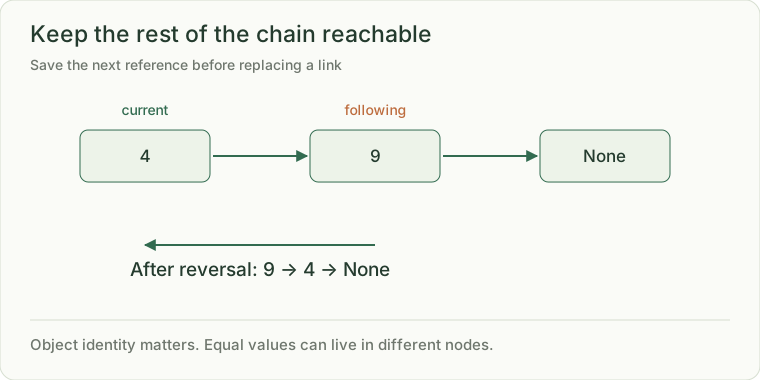
You are reversing a chain of records without allocating replacement nodes. Changing the first link can make the rest of the records unreachable if you have not saved another reference to them. Follow the two-node example below and name which variable still reaches each node after every assignment.
A linked-list node stores a value and a reference to another node. An array index locates a slot; a link points to an object. To reach the third node from the head, follow two links. The useful skill is changing connections without losing the remaining chain.
from dataclasses import dataclass

@dataclass(eq=False)
class Node:
    value: int
    next: "Node | None" = None

head = Node(4, Node(9))
print(head.next.value)  # 9
eq=False keeps node identity meaningful: two separate nodes containing 4 are not the same node. The end is None. An empty list has head = None.
Change one link safely
To reverse a chain, save the unreversed suffix before replacing a link:
previous = None
current = head
while current is not None:
    following = current.next
    current.next = previous
    previous = current
    current = following
head = previous
After each iteration, previous owns the reversed prefix and current owns the remaining suffix. Reversing 4 → 9 → None yields 9 → 4 → None; forgetting following can disconnect the 9.
Cost depends on the handle you have
Finding an arbitrary value is O(n). Inserting after an already-known node is O(1). In a singly linked list, deleting a known node may still require its predecessor. A doubly linked list stores both previous and next, enabling O(1) removal with a node handle at the cost of more links to maintain.
This is why an LRU cache combines a dictionary with a doubly linked list: the map finds the node, and the list moves it in recency order. State explicitly whether an operation reuses caller-owned nodes or returns a new chain.
Check: empty and one-node chains survive reversal; repeated values remain separate nodes; a cycle needs detection or a documented exclusion before a traversal can terminate.
Trace the first reversal step
For the initial chain 4 then 9, all variables refer to nodes or None:
| Assignment | What remains reachable |
|---|---|
following = current.next |
following still reaches node 9 |
current.next = previous |
Node 4 now ends at None |
previous = current |
previous reaches the reversed prefix, node 4 |
current = following |
current reaches the unprocessed suffix, node 9 |
Without the first assignment, reading current.next after overwriting it would yield None. The value 9 still exists in memory only if another reference kept it alive, but this algorithm would have lost its route to it.