Choose harder constraints after a small system works
Start with one concrete product: a team reading list where users save and edit documentation links. A first implementation needs a browser, an API and stored bookmarks. More demanding follow-ups introduce competing edits, overload, multiple teams and live migrations. Use this page to choose the next constraint you can explain and implement, rather than adding services to make a diagram look senior.
These are assessment checkpoints for one curriculum. Foundation, operating constraints, and broader ownership are follow-ups within the same lesson; they are not separate reading paths. Use the curriculum for learning order. The preserved level expectations below are practice criteria, not company-wide hiring rules.
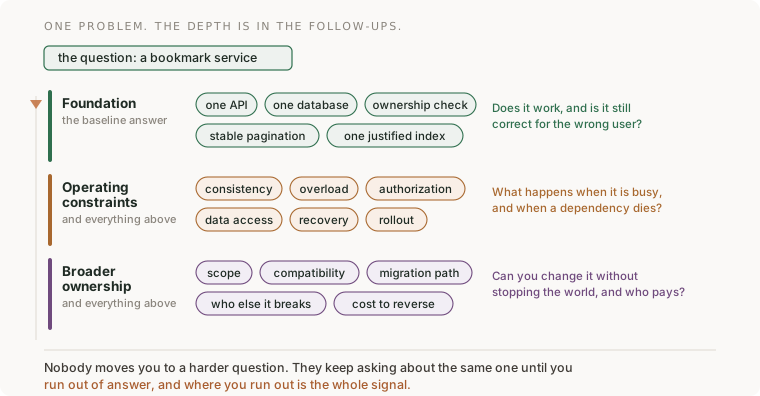
Foundation
Start with HTTP, browser state, data modelling, indexes, validation, and tests. Draw where a request waits and who owns every piece of state. Learn arrays/maps, binary search, stack/queue, BFS/DFS, and basic dynamic programming. Junior design depth varies significantly by employer; use the recruiter packet to set the time split.
Practice checkpoints
- Review the coding foundations, then implement two-sum, a sliding window, binary search, and BFS.
- Build the bookmark API and UI exercise in full stack. Include loading, empty, error, and success states.
- Run AWS lab 1, then the queue lab at its foundation scope. Explain IAM roles versus user authentication.
- Solve a 30-minute coding mock and a 25-minute small-feature design mock.
- Prepare two true stories: a bug you owned and feedback that changed your implementation.
Related concepts: architecture · coding · AWS · full stack.
Same question, deeper evidence
Practice prompt: A bookmark service.
| Standard | What the answer demonstrates |
|---|---|
| Meets this practice level | One API plus database, ownership checks, stable pagination, and one index justified by a query. |
| Goes further | Show an out-of-order response bug and fix it; test that a different user cannot access a bookmark. |
| Trap | Do not introduce microservices to avoid describing a schema. |
Evidence to assess
- From a fresh contract, implement a small correct feature, including empty/error states and an ownership failure test.
- Draw browser, API, database and an index; explain each request and write without naming extra services to avoid the schema.
- Solve a maps/window/search/tree problem independently and give input-size and auxiliary-space bounds.
- Repeat a different candidate exercise on a later occasion. Keep failed tests and repairs in the attempt record; use the rubric to select a prerequisite, not predict a hiring result.
Operating constraints
Use the deeper follow-ups within each subject as a diagnostic. If you can explain a concept and implement its critical mechanism, move to timed practice. Spend the most time on the constraints you cannot yet defend: consistency, overload, authorization, data access, recovery, and rollout. Keep coding in the rotation.
Practice checkpoints
- Attempt a 45-minute design mock before reading its solution. Record your weakest dimensions.
- Work through architecture concepts and the notification and file-sync designs. Recalculate their example workloads.
- Run the queue lab; inject duplicate, conflicting, and poison messages. Show which writes actually happen.
- Complete the Python set and TypeScript concurrency, cancellation, and LRU exercises; do the practical bug drill.
- Build the full-stack exercise with optimistic updates and conditional writes.
- Prepare six project stories and repeat two design mocks with a new constraint halfway through.
Related concepts: architecture · coding · AWS · full stack.
Same question, deeper evidence
Practice prompt: A notification platform.
| Standard | What the answer demonstrates |
|---|---|
| Meets this practice level | Durable acceptance, bounded workers, retry policy, deduplication boundary, offline users, metrics, and a cost model. |
| Goes further | Demonstrate the crash-after-effect case; explain why a timeout does not prove a write failed. |
| Trap | A cache cannot protect the database if every request bypasses it during a cache outage. |
Evidence to assess
- Implement the importer against unseen pages and explain replay, conflicts, deadlines and crash recovery.
- Demonstrate save A/type B and lost acknowledgments in the editor; draw the changed state and write predicates.
- During an unfamiliar design session, calculate capacity, identify the consistency authority, and adapt when a worker crashes after an external effect.
- Complete two independent unfamiliar occasions using dimension gates. A severe invariant failure cannot be averaged away by polished presentation. Preserve assessor observations and corrected artifacts.
Broader technical ownership
Staff preparation adds scope, sequencing, and influence to hands-on correctness. Start with the operating-constraint checks above; do not use strategy language to hide an unexplained data path. Treat disagreements and organisational constraints as design inputs. This is a practice rubric, not a claim that every employer runs a special staff round.
Practice checkpoints
- Complete the operating-constraint diagnostic and maintain weekly timed coding practice.
- Work the multi-tenant migration design. Identify service owners, contracts, and data invariants before components.
- Extend the AWS lab with tenant quotas and a regional recovery design; document what is implemented and what is only proposed.
- Write a two-page decision memo: options, cost assumptions, smallest experiment, ownership, milestones, and cancellation criteria.
- Run a 60-minute design mock: change a business requirement at minute 25 and remove a dependency at minute 40.
- Prepare stories about cross-team disagreement, a strategy you changed, an incident, and an initiative you stopped or simplified.
Related concepts: architecture · coding · AWS · full stack.
Same question, deeper evidence
Practice prompt: Move a shared platform between data models.
| Standard | What the answer demonstrates |
|---|---|
| Meets this practice level | Compatibility across independently deployed clients, backfill, reconciliation, staged adoption, rollback, and retirement ownership. |
| Goes further | Quantify migration load and duplicate costs; distinguish reversible routing from irreversible data loss. |
| Trap | “We aligned stakeholders” needs the actual disagreement, your intervention, evidence, and outcome. |
Evidence to assess
- Meet the senior implementation gates, including hands-on coding and a failure reproduction; a strategy memo does not replace them.
- Draw independent producer/consumer rollouts, old/new data ownership, backfill plus tombstones, and a repair path. State when rollback stops being safe.
- Quantify regional recovery capacity and data-loss limits; assign owners, compatibility tests, stop conditions and retirement evidence across teams.
- Adapt to two staged constraint changes in the design assessor pack. Use the fictional scored lead example to calibrate evidence, then record two independently assessed unfamiliar occasions of your own.