Measure whether existing checks detect real defects
Application background
A bookmark application already has automated checks that report success. Its maintainers want to know whether those checks would actually notice a serious mistake, such as letting Bob edit Alice's bookmark. A green result alone does not answer that question.
In a disposable copy, deliberately introduce one small defect at a time and observe which existing checks detect it. This is an exercise in evaluating the evidence you already have. The result is a report about detected and missed behavior changes.
Example walkthrough
| Action | Expected behavior |
|---|---|
| Remove the owner condition from bookmark editing | Observe whether an existing check reports the unauthorized edit. |
| Change the expiry comparison at its exact boundary | Observe whether the existing checks notice the changed result. |
| Restore the original behavior | Record which checks detected each defect and which gaps remain. |
A mutation is a deliberate small code change used to challenge the checks. Sensitivity describes whether the available evidence responds when the protected behavior breaks.
Your assignment
Deliver: Produce a report showing which deliberate defects the existing checks detect and which they miss. Do the experiment in a disposable copy and keep each observation tied to the change that caused it.
Required behavior: Distinguish meaningful behavior changes from equivalent edits. Report which selected defects are detected, which survive and which time out. A percentage over a small selected set is evidence about that set, not proof of all correctness.
The primary deliverable is the report or operational procedure named above, backed by a reproducible local demonstration. Build the smallest supporting code needed to make that evidence visible.
Get the code and run the supplied example
The code is in the public junior-to-staff repository. Install Git and Python 3.12+. No AWS account or Python packages are required for this first run. If you already have a checkout, use it and skip cloning.
git clone https://github.com/Soulful-Iris/junior-to-staff.git
cd junior-to-staff
python3 examples/architecture-starts/01_the_suite_that_can_fail.py
Supplied file: examples/architecture-starts/01_the_suite_that_can_fail.py. You can also read or download the source here (download file, source below).
Read the supplied code · 01_the_suite_that_can_fail.py
"""Local mechanism demonstration for 01-the-suite-that-can-fail. No AWS resources are created."""
records=[('owner filter','semantic','detected'),('expiry boundary','semantic','survived'),('comment','equivalent','excluded'),('local rename','equivalent','excluded')]
relevant=[r for r in records if r[1]=='semantic']
print('Selected semantic defects:',len(relevant))
print('Detected:',sum(r[2]=='detected' for r in relevant))
print('Needs investigation:',[r[0] for r in relevant if r[2]=='survived'])
This program is a mechanism demonstration: it runs the small scenario in one process and prints the result. It is not an HTTP service, a complete application, or an AWS deployment. A successful run demonstrates this mechanism only. It does not establish the workload or failure guarantees of the application you will build.
Example output from the supplied run:
Generated IDs and timestamps may differ. Compare the state transitions and outcomes.
Selected semantic defects: 2
Detected: 1
Needs investigation: ['expiry boundary']
Set up your implementation workspace
Create work/01-the-suite-that-can-fail/ in your checkout (or use a separate repository). Copy the supplied mechanism into that directory as mechanism.py, then extract its state transitions into functions you can call from your implementation. The record and module names below describe what you must implement. They are not a promise that files with those names already exist. Keep a README.md beside your implementation with its exact run commands and observed results.
Local components and state to implement
This table names the records, interfaces or decision inputs for your deliverable. Unless a name is explicitly linked to supplied source above, it is something you create. Implement the local state transitions first, then connect the HTTP, storage or worker boundaries required by the steps.
| Record / module | Key or interface | Responsibility |
|---|---|---|
| mutation_record | edit_id,changed_behavior,scope | Why the edit is relevant to the contract. |
| observation | edit_id,input,outcome,elapsed | Reproducible evidence from an isolated run. |
| review_report | detected,survived,timed_out,excluded | Honest denominator and remaining uncertainty. |
Implement the assignment
1. Choose the protected behavior
Open an existing ownership/expiry implementation and write its exact examples: Ben must not see Ana’s record. A record is expired at now >= expires_at. Keep the original program and environment fixed while changing one behavior at a time.
2. Classify candidate edits
Remove the owner predicate and change the expiry comparison independently. Exclude comments and equivalent renames from the semantic denominator. Inspect whether the edit is reachable and actually changes the contract before calling it a surviving defect.
3. Capture isolated outcomes
Run each selected version in a disposable directory with a fixed input and deadline. Record normal failure, timeout, execution error and survival separately. Keep the smallest input that exposes a missed behavior. Do not manufacture a failure when the current evidence already catches the defect.
4. Write the engineering conclusion
Name the uncovered boundary and the evidence needed to protect it. Report sampled scope and limitations. Keep this as a learning exercise and review artifact. No CI requirement or automatic website-publishing check is introduced.
Demonstrate the completed local result
| Action | Expected visible result |
|---|---|
| Run the starting program | The report uses two semantic candidates and names the surviving expiry boundary. |
| Use a comment-only edit | It is excluded rather than counted as a missed defect. |
| Make an edit loop forever | The outcome is timeout with its input retained, not an invented pass. |
Handoff: In your implementation README, include the start command, one successful operation, the failure case above and the resulting stored state or decision. State which dependencies are simulated. Someone with a fresh checkout should be able to reproduce this without your chat history.
Workload assumptions and capacity decisions
These are constructed exercise assumptions. The stated workload is a design target. The local demonstration does not establish that throughput. Use the estimation constants to check units before choosing capacity.
| Input or objective | Calculation / consequence |
|---|---|
| Four proposed edits | Missing owner filter and < changed to <= are semantic candidates. A comment change and a safe local rename are excluded. |
| Two relevant semantic candidates | One detected and one surviving means 50% of this selected set, not 25% of all four textual edits. |
| Ten-second execution deadline assumption | A hang is recorded separately from an assertion failure and a normal pass. |
Map the local implementation to AWS
Deployment status: local only. Running the supplied command creates no AWS resources and configures no cloud connections. The diagram is a proposed deployment of the completed application. Each box needs either a deployed runtime, a provisioned service or an explicitly external dependency.
Read the diagram by following the arrows from the entry point: application code accepts the request or event, the state owner commits it, and any worker produces the later result. The table ties those roles to code and adapter work. Multiple boxes do not imply multiple Python files already exist.
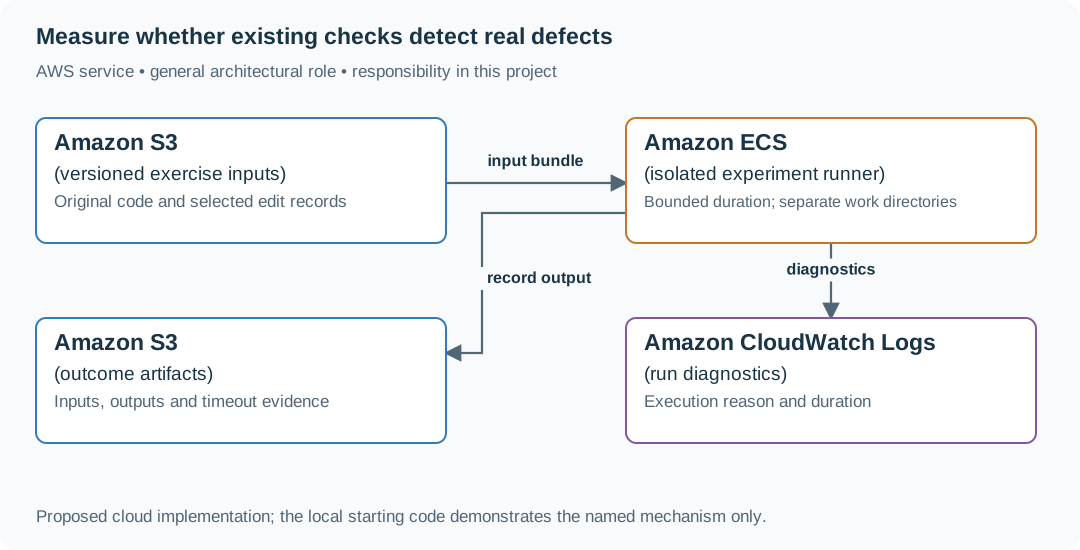
The cloud version is a bounded experiment runner with durable evidence. S3 or ECS does not decide whether a mutation is meaningful. That judgment comes from the stated behavior contract.
| Local responsibility | Cloud destination and role | Implementation still required |
|---|---|---|
| Local file, object fixture or exported payload | Amazon S3: versioned exercise inputs | Implement upload/download and metadata adapters, scoped access, object naming, retention and incomplete-upload cleanup. |
| Application or worker process | Amazon ECS: isolated experiment runner | Build a container and task definition. Supply configuration, task roles and graceful shutdown behavior. |
| Local file, object fixture or exported payload | Amazon S3: outcome artifacts | Implement upload/download and metadata adapters, scoped access, object naming, retention and incomplete-upload cleanup. |
| Local diagnostic events | Amazon CloudWatch Logs: run diagnostics | Emit structured JSON from the deployed runtime and configure log delivery, retention and query permissions. |
Provision resources, then connect the application
| Resource or boundary | Initial configuration and reason |
|---|---|
| Local first | Use separate temporary directories and fixed inputs. Cloud execution is optional for larger experiment batches. |
| Runner | No production credentials. CPU/memory/wall limits and cleanup after every run. |
| Artifacts | Store commit identity and selected edits with outcomes. Exclude secrets and unrelated user data. |
Use one disposable AWS environment for the cloud exercise. Put the named resources in infra/template.yaml or your existing IaC tool, pass resource IDs through configuration, and scope each runtime role to its own tables, buckets and queues. The diagram is a design to implement. It is not a claim that these resources have been deployed. Record the commands you used to deploy and remove the exercise resources.
For concrete provisioning commands, configuration wiring and cleanup, use the AWS foundation guide. It includes a deployable table/queue/object-storage foundation and explains which application and service adapters you still implement.
A provisioned queue or table does not make the local program use it. Configure resource IDs in the deployed runtime, replace the local adapter, and replay the same successful and failing operation against that runtime. Record the deployed commit and observable result, then remove the disposable resources using your infrastructure tool.
Extend the design after the baseline works
All twenty selected defects are detected. Report that result and the sampled risks honestly. Expand coverage only for a concrete uncovered behavior, not to meet a quota of failures.
Follow-up scenarios and worked designs
Follow-up 1 · A mutant hangs
One mutant creates an infinite loop. Does that count as a successful detection?
Worked design and implementation
Record timeout separately and impose a runner deadline. If termination is part of the contract it is a detected harm, but it is not a passing assertion. Retain the smallest hanging input.
Extend the runner contract. Execute each candidate in a child process with an explicit elapsed-time limit and a termination path. Classify assertion failure, timeout, crash and infrastructure error separately. A timeout can reveal a termination defect, but it does not prove the expected output assertion ran.
Hand over a smallest hanging input, its deadline and the observed process exit. Show that the next candidate still executes after the hung child is stopped. Keep this inside the exercise workspace. It does not require adding checks to this curriculum repository.
Follow-up 2 · All relevant mutants are caught
The suite kills all twenty selected semantic mutants. Must you invent a current regression?
Worked design and implementation
No. Preserve the passing regressions and report the sampled scope. Add new challenge cases based on risks, not a quota of failures. A seeded defect demonstrates sensitivity even after its repair.
Report what the evidence actually covers. Use a ledger with mutation ID, behavior changed, observed detection and reason for any exclusion. Twenty caught mutations means those twenty changes were detected under those inputs. It is not a probability that arbitrary software is correct.
Preserve the now-passing regression examples. Add future challenges when a new risk appears, such as an unexercised overflow boundary. Your handoff should let a reader reproduce one detected defect and see which behaviors were never challenged, without inventing a failure quota.