Queues and deques: control who goes next
A traversal discovers tasks A and B, then discovers C while processing A. Should C jump ahead of B? A first-in, first-out queue says no. You will use the same ordering rule to explain why breadth-first search visits nearby nodes before more distant ones.
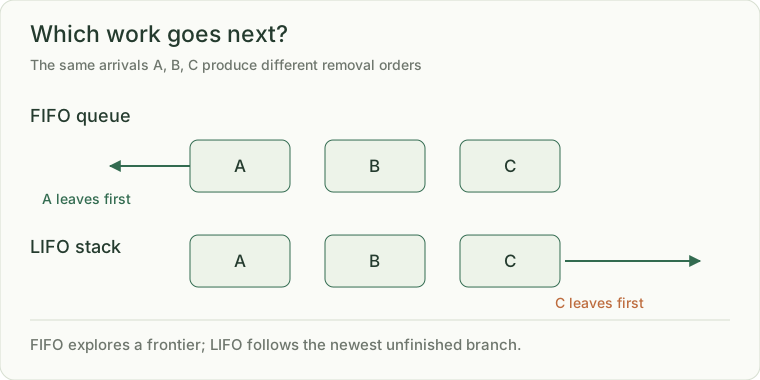
A queue serves the oldest waiting item first (FIFO). A stack serves the newest first (LIFO). A deque supports efficient operations at both ends, so it can implement either policy. The order determines whether a traversal explores nearby states or follows one branch deeply.
from collections import deque

ready = deque(["A", "B"])
ready.append("C")
print(ready.popleft())  # A
print(list(ready))      # ['B', 'C']
Appending and removing at either deque end are O(1). Removing list[0] with pop(0) shifts the remaining entries, making it a poor queue for large traversals. A deque is not intended for fast arbitrary middle indexing.
Use the order as part of the proof
In BFS, newly discovered neighbors join the back while the oldest discovered node leaves the front. Every distance-d node is processed before distance d+1, which gives shortest paths when every edge has equal cost. Mark a node visited when enqueueing it so two parents cannot schedule it twice.
For a tree level, capture the initial queue length, then remove exactly that many nodes; appended children belong to the next level. In a dependency scheduler, the queue holds only work whose prerequisites are complete.
A queue is not a complete work system
An in-memory deque alone does not define capacity, waiting, cancellation, persistence, or concurrent ownership. Those contracts appear later in the bounded queue and durable-job exercises. Here, predict the state after append-left, append-right, pop-left, and pop-right before adding those concerns.
Keep this level separate from the next one
Suppose the current tree frontier is [B, C]. B has children D and E. C has child F.
| Step | Queue after the step | Nodes emitted for this level |
|---|---|---|
| Capture level size = 2 | B, C | none |
| Remove B, append D and E | C, D, E | B |
| Remove C, append F | D, E, F | B, C |
Stop after the two captured removals. D, E and F belong to the next level even though they are already in the same queue. If the loop keeps processing until the queue is empty, it loses the level boundary.
Source: Python queue operations