Trace LRU eviction before implementing its linked order
What the cache remembers
A preview service keeps a few decoded objects so repeated reads can reuse them. Capacity counts entries in this exercise. When a new entry would exceed the limit, the service removes the entry whose most recent successful use is oldest. Reading a present entry changes that order even though its value stays the same.
Your task is to trace the sequence below, then implement the complete linked-list problem. No AWS cache is required. The shared LRU helper linked at the end uses an ordered-map library, while the standalone problem deliberately asks you to implement recency pointers yourself.
“Capacity is two entries: put a, put b, get a, then put c. Which key must disappear, and what must remain constant-time?”
Evict b. Lookup and eviction order are different responsibilities; derive the map and pointer invariants before writing get or put.
This is a short prerequisite lesson. Attempt the complete manual lru cache problem, then expiring key value store, with their contracts, tests and changed requirements.
Build: Implement get and put for a cache with capacity measured in entries.
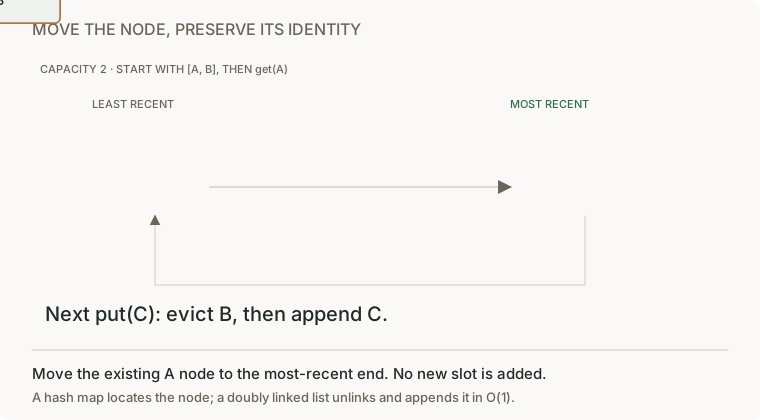
The idea: The map finds an entry. Recency order chooses eviction. A get moves the existing node to the most-recent end.
| Operation | Least recent → most recent | Outcome |
|---|---|---|
| Put a | a | One entry |
| Put b | a, b | Capacity reached |
| Get a | b, a | Reading a refreshes its position |
| Put c | a, c | Evict b, which was used least recently |
Your 45-minute session
- 5 min: draw one example and a simple solution.
- 25 min: implement
LRUwithout the reference. - 10 min: test Capacity zero; overwrite; miss; get refreshes recency; put A, put B, get A, put C evicts B.
- 5 min: explain the cost and answer the changed requirement.
Cost: Scanning recency: O(capacity). Map plus linked order: expected O(1) get/put, O(capacity) space.
Pass before moving on: Show how one node is detached and reattached. Do not explain only OrderedDict syntax.
Capacity is now bytes, with TTL. Can one insertion still guarantee O(1) work?
After attempting: reference and explanation
Compare LRU in algorithms.py (download file, source below). Use pattern notes for the invariant and contracts for complexity edge cases. Reimplement tomorrow without copying.
"""Reference solutions. Try the exercises in README.md before opening this file."""
from collections import Counter, OrderedDict, deque
from heapq import heappop, heappush, nlargest


def two_sum(nums, target):
    visited = {}
    for j, value in enumerate(nums):
        complement = target - value
        if complement in visited:
            return visited[complement], j
        visited.setdefault(value, j)
    return None


def longest_unique(text):
    left = best = 0
    last_seen = {}
    for right, char in enumerate(text):
        left = max(left, last_seen.get(char, -1) + 1)
        best = max(best, right - left + 1)
        last_seen[char] = right
    return best


def subarray_sum(nums, target):
    prefix_counts = {0: 1}
    prefix = result = 0
    for value in nums:
        prefix += value
        result += prefix_counts.get(prefix - target, 0)
        prefix_counts[prefix] = prefix_counts.get(prefix, 0) + 1
    return result


def lower_bound(nums, target):
    lo, hi = 0, len(nums)
    while lo < hi:
        mid = lo + (hi - lo) // 2
        if nums[mid] < target:
            lo = mid + 1
        else:
            hi = mid
    return lo


def merge_intervals(intervals):
    """Closed intervals; touching endpoints merge. Does not mutate input."""
    out = []
    for start, end in sorted(intervals):
        if start > end:
            raise ValueError('reversed interval')
        if out and start <= out[-1][1]:
            out[-1][1] = max(out[-1][1], end)
        else:
            out.append([start, end])
    return out


def top_k_frequent(nums, k):
    if k < 0:
        raise ValueError('k must be nonnegative')
    counts = Counter(nums)
    # Higher count wins; smaller value breaks ties deterministically.
    return nlargest(k, counts, key=lambda value: (counts[value], -value))


def islands(grid):
    """Rectangular list of lists of '0'/'1'; input remains unchanged."""
    if not grid:
        return 0
    cols = len(grid[0])
    if any(len(row) != cols or any(x not in ('0', '1') for x in row) for row in grid):
        raise ValueError('expected rectangular binary grid')
    seen = set()
    count = 0
    for r, row in enumerate(grid):
        for c, value in enumerate(row):
            if value != '1' or (r, c) in seen:
                continue
            count += 1
            seen.add((r, c))
            queue = deque([(r, c)])
            while queue:
                x, y = queue.popleft()
                for a, b in ((x-1, y), (x+1, y), (x, y-1), (x, y+1)):
                    if 0 <= a < len(grid) and 0 <= b < cols and grid[a][b] == '1' and (a, b) not in seen:
                        seen.add((a, b))  # Mark on enqueue, not dequeue.
                        queue.append((a, b))
    return count


def course_order(n, prerequisites):
    """Each pair is (course, prerequisite); [] means a cycle or no courses."""
    if n < 0:
        raise ValueError('negative course count')
    adjacency = [set() for _ in range(n)]
    degree = [0] * n
    for course, prerequisite in prerequisites:
        if not 0 <= course < n or not 0 <= prerequisite < n:
            raise ValueError('course outside graph')
        if course not in adjacency[prerequisite]:
            adjacency[prerequisite].add(course)
            degree[course] += 1
    queue = deque(i for i, d in enumerate(degree) if d == 0)
    order = []
    while queue:
        node = queue.popleft()
        order.append(node)
        for neighbor in adjacency[node]:
            degree[neighbor] -= 1
            if degree[neighbor] == 0:
                queue.append(neighbor)
    return order if len(order) == n else []


def shortest_paths(n, edges, source):
    """Directed nonnegative weighted graph; unreachable distances are infinity."""
    if not 0 <= source < n:
        raise ValueError('invalid source')
    graph = [[] for _ in range(n)]
    for u, v, weight in edges:
        if not 0 <= u < n or not 0 <= v < n or weight < 0:
            raise ValueError('invalid edge')
        graph[u].append((v, weight))
    distance = [float('inf')] * n
    distance[source] = 0
    heap = [(0, source)]
    while heap:
        cost, node = heappop(heap)
        if cost != distance[node]:
            continue
        for neighbor, weight in graph[node]:
            candidate = cost + weight
            if candidate < distance[neighbor]:
                distance[neighbor] = candidate
                heappush(heap, (candidate, neighbor))
    return distance


class LRU:
    """Capacity in entries; None denotes a miss. Not thread-safe."""
    def __init__(self, capacity):
        if capacity < 0:
            raise ValueError('negative capacity')
        self.capacity = capacity
        self.data = OrderedDict()

    def get(self, key):
        if key not in self.data:
            return None
        self.data.move_to_end(key)
        return self.data[key]

    def put(self, key, value):
        if self.capacity == 0:
            return
        self.data[key] = value
        self.data.move_to_end(key)
        if len(self.data) > self.capacity:
            self.data.popitem(last=False)


def min_coins(coins, amount):
    if amount < 0 or any(c <= 0 for c in coins):
        raise ValueError('nonnegative amount and positive coins required')
    dp = [0] + [amount + 1] * amount
    for total in range(1, amount + 1):
        for coin in coins:
            if coin <= total:
                dp[total] = min(dp[total], dp[total-coin] + 1)
    return -1 if dp[amount] > amount else dp[amount]


def daily_temperatures(temperatures):
    answer = [0] * len(temperatures)
    stack = []
    for i, temp in enumerate(temperatures):
        while stack and temperatures[stack[-1]] < temp:
            previous = stack.pop()
            answer[previous] = i - previous
        stack.append(i)
    return answer


def word_exists(board, word):
    """4-neighbor word search; do not reuse a cell or mutate the board."""
    if not word:
        return True
    if not board:
        return False
    cols = len(board[0])
    if any(len(row) != cols for row in board):
        raise ValueError('ragged board')
    def visit(r, c, index, used):
        if not (0 <= r < len(board) and 0 <= c < cols) or (r, c) in used or board[r][c] != word[index]:
            return False
        if index == len(word) - 1:
            return True
        used.add((r, c))
        found = any(visit(a, b, index+1, used) for a, b in ((r+1,c),(r-1,c),(r,c+1),(r,c-1)))
        used.remove((r, c))
        return found
    return any(visit(r, c, 0, set()) for r in range(len(board)) for c in range(cols))


class Trie:
    END = object()

    def __init__(self):
        self.root = {}

    def insert(self, word):
        node = self.root
        for char in word:
            node = node.setdefault(char, {})
        node[self.END] = True

    def contains(self, word):
        node = self.root
        for char in word:
            if char not in node:
                return False
            node = node[char]
        return self.END in node