Repair decimal amounts and restart recovery in a transaction importer
Application and assignment
A finance job downloads pages of transaction records from a partner and stores amounts as integer cents. It remembers a page cursor so a later invocation can continue. If amounts are rounded incorrectly or progress advances before a page is stored, reconciliation is wrong even when every HTTP response succeeds.
You receive an unfamiliar Python package, fixtures, and a separate reference solution. Diagnose the 29-cent loss and skipped-page symptom, repair the package, and explain how identity and progress remain correct after a restart. The exercise stores synthetic records. It moves no real money.
Contract and starting evidence
“Finance imports USD transactions from a partner. Yesterday's reconciliation lost 29 cents and a restart skipped a page. The partner says its API is healthy. Complete this package without changing transaction identity. What do you inspect first?”
This is a constructed 75-minute practical/debug session. Start with
the candidate brief; keep
the assessor key and reference/ closed on the first attempt.
Prerequisites: maps and identity,
runtime boundaries, and the assessment rubric.
| Contract | Expected behavior |
|---|---|
| Input | Pages of {id, amount: decimal-string, currency: "USD"}, opaque next cursor or null |
| Worked output | a:"0.29", b:"-1.10", followed by duplicate a and c:"0.00" → (a,29),(b,-110),(c,0) cents |
| Identity | Equal ID/equal normalized payload replays harmlessly; equal ID/different payload fails the entire page |
| Bounds | At most 100 pages per invocation, 3 attempts per page, total 5-second budget checked at transport and durable boundaries; amount strings at most 128 characters and absolute amount at most 10 billion USD |
| Failure | "0.001" on page 2 rejects page 2; page 1 remains durable and checkpoint stays at page 2 |
| Scope | One importer at a time; USD whole cents; Retry-After is numeric seconds by partner contract; no real money movement |
The deadline is cooperative at the store boundary: it does not interrupt a SQLite commit already in progress. If time expires after persistence, progress is left for safe replay and no success is returned. Decimal coefficient/exponent conversion is independent of the ambient decimal precision; a tiny fractional cent cannot round away before validation.
Run and investigate
From the repository root:
cd curriculum/02-applications/04-testing/labs/importer
PACKAGE=starter python -m unittest test_importer -v
# After your independent repair; supplied solution check is a different activity:
PACKAGE=reference python -m unittest test_importer -v
Requires Python 3.10+ and the standard library. SQLite files are temporary in tests.
The starter deliberately has a syntax failure; a failed first command is expected.
Baseline output (download file, source below) records what happens before any repair. Read modules
in dependency order: domain model, HTTP transport, persistence store, coordinator
importer. Do not replace the package with one script. Candidate edits belong in
starter/; never count green reference tests as candidate evidence.
Read the supplied code · baseline.txt
test_importer (unittest.loader._FailedTest.test_importer) ... ERROR

======================================================================
ERROR: test_importer (unittest.loader._FailedTest.test_importer)
----------------------------------------------------------------------
ImportError: Failed to import test module: test_importer
Traceback (most recent call last):
  File "/opt/codex/runtimes/codex-primary-runtime/dependencies/python/lib/python3.12/unittest/loader.py", line 396, in _find_test_path
    module = self._get_module_from_name(name)
             ^^^^^^^^^^^^^^^^^^^^^^^^^^^^^^^^
  File "/opt/codex/runtimes/codex-primary-runtime/dependencies/python/lib/python3.12/unittest/loader.py", line 339, in _get_module_from_name
    __import__(name)
  File "/workspace/scratch/9c065dc5ca83/junior-to-staff/paths/interviews/coding/labs/importer/test_importer.py", line 12, in <module>
    Store = importlib.import_module(package + ".store").Store
            ^^^^^^^^^^^^^^^^^^^^^^^^^^^^^^^^^^^^^^^^^^^
  File "/opt/codex/runtimes/codex-primary-runtime/dependencies/python/lib/python3.12/importlib/__init__.py", line 90, in import_module
    return _bootstrap._gcd_import(name[level:], package, level)
           ^^^^^^^^^^^^^^^^^^^^^^^^^^^^^^^^^^^^^^^^^^^^^^^^^^^^
  File "/workspace/scratch/9c065dc5ca83/junior-to-staff/paths/interviews/coding/labs/importer/starter/store.py", line 24
    def advance(self, cursor)
                             ^
SyntaxError: expected ':'


----------------------------------------------------------------------
Ran 1 test in 0.000s

FAILED (errors=1)
Start with the smallest useful trace
- Restate identity and amount units. Write the 29-cent example before touching code.
- Run the command; separate “cannot import” from “incorrect business result.” Fix one executable boundary, then rerun. Record a hypothesis and the smallest input that distinguishes it from another cause.
- Map one page through validation, persistence, and checkpointing. Ask who owns each acknowledgment. A misleading comment calls early checkpointing “faster”; a successful transport log says nothing about durable rows.
- Add one injected failure at a time. Inspect actual calls and fake-clock values, not elapsed sleep time. Preserve passing callers while changing a boundary.
- Prove replay safety and termination separately. A page limit bounds a loop but does not explain a repeated cursor or detect conflicting business identity.
The starting failure path acknowledges progress before the durable effect:

Before reading the next diagram, predict the rows and cursor after a crash immediately after persisting page 1. Which operation must be safe to repeat?
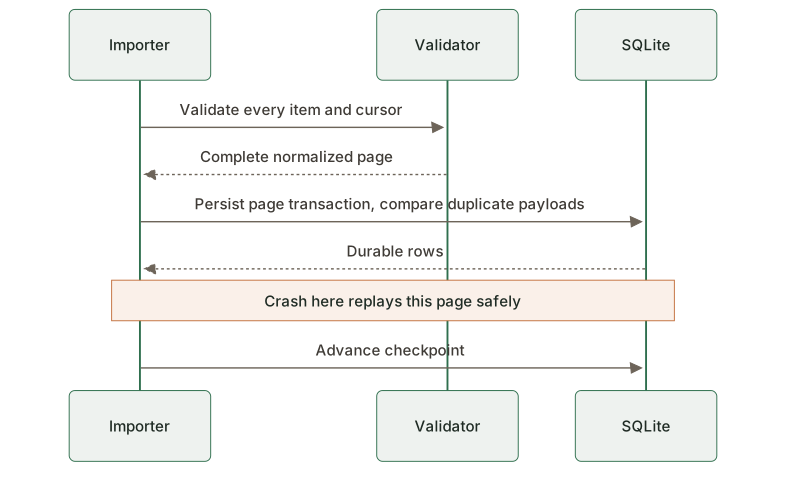
Validation before mutation prevents half a malformed page from appearing. Compare existing payloads inside the page transaction, so a late conflict rolls back earlier inserts from that page. Keeping progress separate intentionally teaches replay; an atomic page-plus-checkpoint transaction is also a valid design if the assessment contract and crash tests are changed consistently.
Changed constraints
Question 1: The partner returns p2 → p3 → p2. Is checking only next == current
enough? Expected reasoning: no; retain the set of requested cursors, reject any
non-null next cursor already seen, and retain a finite page budget. Space is O(P)
cursor history plus the page's O(m) normalized items; retained store/output is O(n).
The final sorted output adds O(n log n) ordering cost unless the storage index supplies
that order. Transport/SQLite costs are not hidden inside a claimed O(n/P) wall time.
Question 2: HTTP 429 arrives after 0.3 seconds with Retry-After: 0.8 and the total
budget is 1 second. Expected answer: refuse the retry at fake time 0.3; do not
sleep 0.8 or start another request. Pass only remaining budget to the transport.

Question 3: The process dies after the page commits, before checkpointing. Expected answer: reopening the same SQLite file replays equal IDs without double counting; conflicting payloads remain errors. A finished checkpoint is distinct from the initial null cursor. Tests reopen a real database connection.
Senior evidence is a narrow repair, causally meaningful regressions, and explicit resource/failure bounds. Lead evidence adds partner-contract ownership, reconciliation metrics, migration compatibility and a rollout that keeps the old checkpoint readable. Finish with the separate three-PR review. Do a second unfamiliar session on a later occasion; this is curriculum evidence, not a hiring probability.