Frontend state and API integration
Preserve user intent across browser, API, and persisted state.
Preserve the user’s next edit while the network catches up
Ana saves a bookmark title, then immediately keeps typing. The first response must confirm the submitted title without overwriting her newer draft. The same distinction between user intent and arriving data matters for search, loading, errors, focus, and navigation.
Open the supplied bookmark editor to see a real browser talking to an HTTP API and SQLite. Inspect its visible states, then work through the response ordering and version boundaries. The editor begins with seeded records and supports editing. Adding new bookmarks is a separate feature.
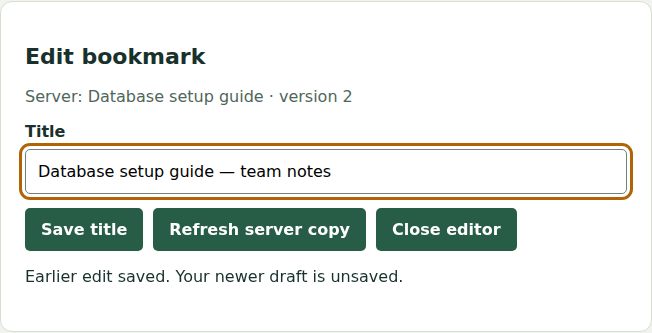
The confirmed title and editable draft are deliberately different. The browser preserves the newer typing after the earlier save completes.
Parts group related chapters. Each lesson has a chapter.lesson address, such as 4.07. Open a title below, or use Next to follow the reading sequence. Within a lesson, On this page lists its sections.
- 6.01
Keep browser drafts, saved data and search results consistent
Concepts and examples
- 6.02
Search race · the latest user intent wins
Concepts and examples
- 6.03
Full stack · one user action across every boundary
Concepts and examples
- 6.04
Bookmark editor · preserve the user's next edit
Concepts and examples
- 6.05
- 6.06
Stage 1: Build the shared reading-list application
Projects and practical assessment
- 6.07
Build a bookmark editor that preserves typing during a save
Projects and practical assessment