Arrays and strings: keep order and boundaries
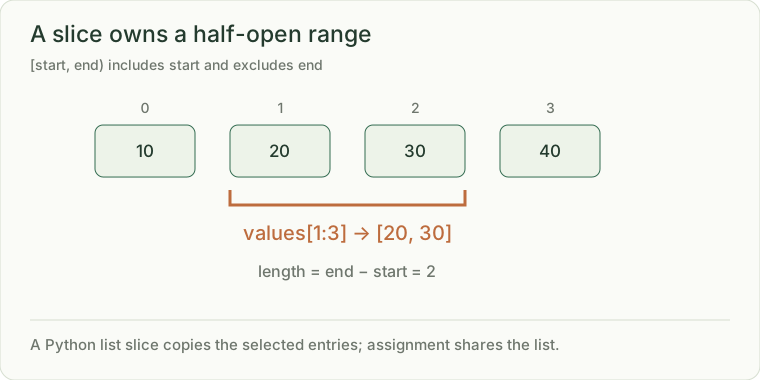
A page shows the first ten bookmarks from an ordered list. You need to choose a range without skipping the tenth item, and decide whether editing that range should change the original list. Work through the slice example below, then distinguish a contiguous range from a selection that skips positions.
A sequence keeps values in order. Python's list is a resizable array: an index locates an item directly. A string is an immutable sequence of Unicode code points. These are the inputs many interview algorithms traverse.
Read, copy, and mutate deliberately
values = [10, 20, 30, 40]
window = values[1:3]
window[0] = 99
print(window)  # [99, 30]
print(values)  # [10, 20, 30, 40]
[1:3] includes index 1 and excludes index 3. Its length is 3 - 1. The slice creates a new list; assigning window = values would instead make both names refer to the same list. A shallow copy still shares nested mutable objects.
The operations shape the algorithm
| Operation on a Python list | Typical bound | What is happening |
|---|---|---|
Read/write values[i] |
O(1) | Locate one slot |
| Append or pop at the end | Amortized O(1) | Change the tail; occasional resize |
| Insert/delete at the front | O(n) | Shift remaining entries |
Membership x in values |
O(n) | Scan until found or exhausted |
| Slice k entries | O(k) | Copy those entries |
Build many string fragments in a list and join once when appropriate; repeated concatenation can repeatedly copy the accumulated text. If a prompt means visible characters, clarify Unicode handling: one visible symbol may span several code points. TypeScript string indices use UTF-16 code units, so do not silently transfer Python character assumptions.
Three different questions
For [1, 3, 2, 4], [3, 2] is a contiguous subarray. [1, 2, 4] is a subsequence that preserves order while skipping positions. {1, 2, 3, 4} is a set that forgets positions. Choosing the wrong one can make a fast solution answer the wrong question.
Boundary check: [] has no valid index; [8] has index 0; values[len(values)] is outside the list. Use half-open ranges consistently when returning start/end positions.
A shallow copy can still share nested data
rows = [["A"], ["B"]]
copy = rows[:]
copy[0].append("edited")
print(rows)  # [['A', 'edited'], ['B']]
The outer list was copied, but its entries still point to the same inner lists. Replacing copy[0] would change only the copied outer list. Mutating the shared inner list changes what both outer lists observe. Draw two outer containers pointing to the same first row before deciding whether your application needs a deeper copy.
Source: Python data structures