Prevent overlapping shifts and enforce manager access
Application background
A café manager assigns employees to shifts at two locations. A shift records a person, location and start/end time. Employees use the schedule to know where to be, so overlapping assignments can create a real staffing problem.
Two managers may edit at once. One might assign Ana from 09:00 to 12:00 while another assigns her from 11:00 to 14:00. A manager can also lose access while an old schedule page remains open in their browser.
Example walkthrough
| Action | Expected behavior |
|---|---|
| Save Ana's 09:00–12:00 shift | Accept it if it does not overlap an existing assignment. |
| Another manager submits 11:00–14:00 for Ana | Reject the overlap rather than storing both. |
| A former manager submits an edit from an open page | Check current authority and reject the edit. |
Checking a browser's earlier view is insufficient. The database operation must protect the overlap rule, and each edit must use the manager's current location permissions.
Your assignment
Deliver: Build shift editing for current managers. Reject overlapping employee shifts and demonstrate that an old open browser page cannot bypass revoked access.
Required behavior: Only current managers may change a location’s schedule. An employee cannot hold overlapping active shifts across locations. Cached schedule visibility and stale browser sessions do not authorize new changes.
The required first milestone is a working local implementation of the behavior above. The numbered implementation steps define the scope. The cloud architecture is a later extension, not something the starter has already provisioned.
Get the code and run the supplied example
The code is in the public junior-to-staff repository. Install Git and Python 3.12+. No AWS account or Python packages are required for this first run. If you already have a checkout, use it and skip cloning.
git clone https://github.com/Soulful-Iris/junior-to-staff.git
cd junior-to-staff
python3 examples/architecture-starts/a_shift_schedule.py
Supplied file: examples/architecture-starts/a_shift_schedule.py. You can also read or download the source here (download file, source below).
Read the supplied code · a_shift_schedule.py
"""Local mechanism demonstration for a-shift-schedule. No AWS resources are created."""
shifts=[('ana',9,12)]; managers={'m1'}
def assign(actor,employee,start,end):
    if actor not in managers: return '403 revoked'
    if any(e==employee and start<b and a<end for e,a,b in shifts): return '409 overlapping shift'
    shifts.append((employee,start,end)); return 'saved'
print(assign('m1','ana',11,14)); print(assign('m1','ana',12,15))
managers.remove('m1'); print(assign('m1','ben',9,12))
This program is a mechanism demonstration: it runs the small scenario in one process and prints the result. It is not an HTTP service, a complete application, or an AWS deployment. A successful run demonstrates this mechanism only. It does not establish the workload or failure guarantees of the application you will build.
Example output from the supplied run:
Generated IDs and timestamps may differ. Compare the state transitions and outcomes.
409 overlapping shift
saved
403 revoked
Set up your implementation workspace
Create work/a-shift-schedule/ in your checkout (or use a separate repository). Copy the supplied mechanism into that directory as mechanism.py, then extract its state transitions into functions you can call from your implementation. The record and module names below describe what you must implement. They are not a promise that files with those names already exist. Keep a README.md beside your implementation with its exact run commands and observed results.
Local components and state to implement
This table names the records, interfaces or decision inputs for your deliverable. Unless a name is explicitly linked to supplied source above, it is something you create. Implement the local state transitions first, then connect the HTTP, storage or worker boundaries required by the steps.
| Record / module | Key or interface | Responsibility |
|---|---|---|
| shifts | employee,start_utc,end_utc,location,version | Authoritative occupancy and conditional edits. |
| manager_membership | subject,location,role,revision | Current write authorization. |
| audit_events | shift,actor,before,after,request_id | Who changed the schedule and why. |
Implement the assignment
1. Model time and overlap
Store UTC instants plus the location timezone needed for display and recurring intent. Use half-open intervals and require end after start. In PostgreSQL, enforce employee/time exclusion in the write transaction. A prior availability query is only advisory.
2. Authorize the actual mutation
Resolve current manager membership for the target location and validate employee eligibility. Scope every query and update. If access changes during a long edit, the final save checks current authority and returns a clear denial without silently losing the draft.
3. Make concurrent changes visible
Require expected shift version for edits/cancellations. Show who changed the latest version and preserve the losing proposal. Commit an audit intent with the change so a crash cannot erase evidence of an accepted schedule edit.
4. Publish and recover schedules
Send notifications asynchronously after commit. A failed notification does not cancel a valid shift. Keep versioned export/print views and demonstrate recovery from backup while preserving accepted assignments and audit history.
Demonstrate the completed local result
| Action | Expected visible result |
|---|---|
| Run the starting program | The overlap is rejected, the adjacent shift succeeds, and revoked m1 cannot assign Ben. |
| Two managers race for one employee | One authoritative transaction rejects the conflict. |
| Stop email delivery | The committed schedule remains correct and notification failure is visible. |
Handoff: In your implementation README, include the start command, one successful operation, the failure case above and the resulting stored state or decision. State which dependencies are simulated. Someone with a fresh checkout should be able to reproduce this without your chat history.
Workload assumptions and capacity decisions
These are constructed exercise assumptions. The stated workload is a design target. The local demonstration does not establish that throughput. Use the estimation constants to check units before choosing capacity.
| Input or objective | Calculation / consequence |
|---|---|
| 40 employees. Two locations. Four weeks visible | A small relational dataset. Correctness matters more than distributed storage. |
| [09:00,12:00) and [11:00,14:00) | They overlap. [12:00,15:00) is a valid adjacent shift. |
| Immediate revocation for new writes | Recheck current membership at commit. Token validity alone is insufficient. |
Map the local implementation to AWS
Deployment status: local only. Running the supplied command creates no AWS resources and configures no cloud connections. The diagram is a proposed deployment of the completed application. Each box needs either a deployed runtime, a provisioned service or an explicitly external dependency.
Read the diagram by following the arrows from the entry point: application code accepts the request or event, the state owner commits it, and any worker produces the later result. The table ties those roles to code and adapter work. Multiple boxes do not imply multiple Python files already exist.
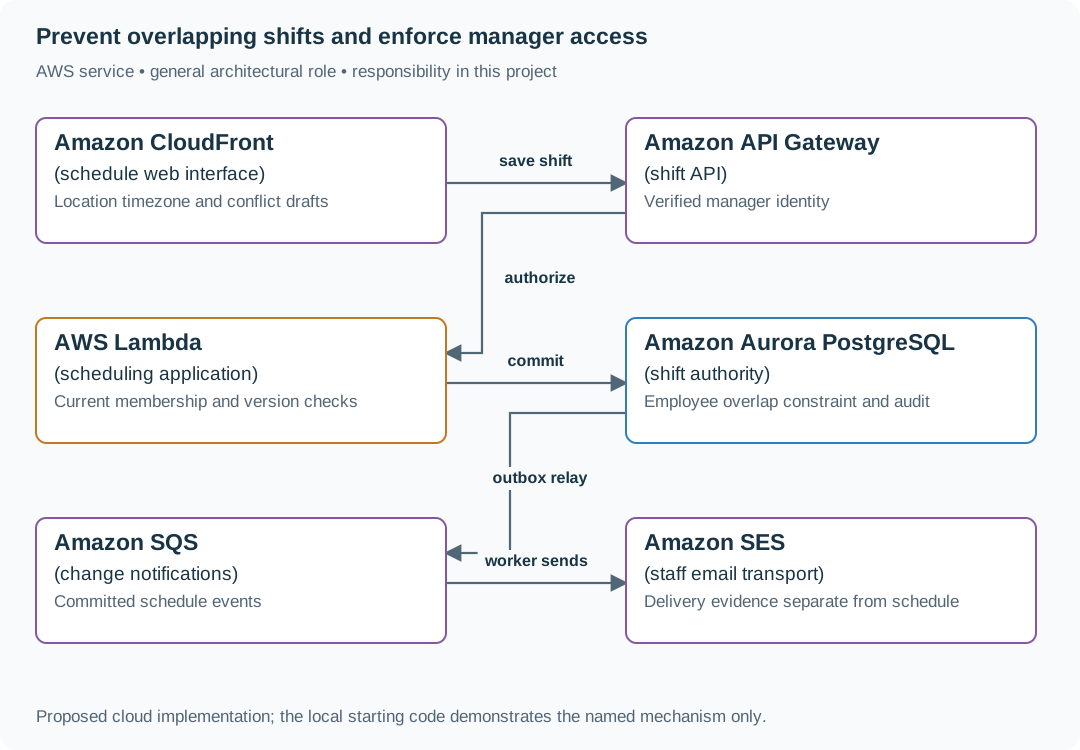
A relational exclusion constraint directly expresses overlapping employee occupancy. Identity and cached UI state are inputs to the workflow, while current membership and the database write decide whether the change is allowed.
| Local responsibility | Cloud destination and role | Implementation still required |
|---|---|---|
| Local static/media delivery path | Amazon CloudFront: schedule web interface | Configure an origin, cache policy and private-content access. Distinguish cached bytes from current authorization. |
| Local HTTP boundary or the endpoint you will add | Amazon API Gateway: shift API | Create routes and an integration. Translate requests and responses and configure identity validation. |
| Python operation or worker function | AWS Lambda: scheduling application | Write a Lambda event adapter, package its dependencies and give its role only the required resource actions. |
| Local records and transaction boundary | Amazon Aurora PostgreSQL: shift authority | Write PostgreSQL schema/migrations and a database adapter. Configure credentials, connection limits and recovery. |
| Local pending-work collection | Amazon SQS: change notifications | Publish committed job intent, consume messages and persist deduplication/ownership state. Add visibility, retry and dead-letter handling. |
| Local notification delivery fixture | Amazon SES: staff email transport | Implement email submission and provider outcome tracking with verified sender configuration and scoped credentials. |
Provision resources, then connect the application
| Resource or boundary | Initial configuration and reason |
|---|---|
| Database | Exclusion constraint by employee/time and short transactions. Index location/date views separately. |
| Authorization | Current membership check for each mutation. No client-supplied manager role. |
| Notifications | Bounded retry and visible failure status without changing committed shift ownership. |
Use one disposable AWS environment for the cloud exercise. Put the named resources in infra/template.yaml or your existing IaC tool, pass resource IDs through configuration, and scope each runtime role to its own tables, buckets and queues. The diagram is a design to implement. It is not a claim that these resources have been deployed. Record the commands you used to deploy and remove the exercise resources.
For concrete provisioning commands, configuration wiring and cleanup, use the AWS foundation guide. It includes a deployable table/queue/object-storage foundation and explains which application and service adapters you still implement.
A provisioned queue or table does not make the local program use it. Configure resource IDs in the deployed runtime, replace the local adapter, and replay the same successful and failing operation against that runtime. Record the deployed commit and observable result, then remove the disposable resources using your infrastructure tool.
Extend the design after the baseline works
Add recurring shifts across a daylight-saving transition. Keep local recurrence intent separate from UTC occurrences and define the policy for nonexistent or ambiguous local times.
Follow-up scenarios and worked designs
Follow-up 1 · A link was cached
You add CloudFront for static assets. What happens to the protected schedule route?
Worked design and implementation
Use a cache-disabled behavior for protected schedule data and no-store responses. Validate the token against the authoritative store for every new request. Fail closed if it is unavailable. Static shell assets may remain cached.
Split delivery by resource type. Cache the HTML, JavaScript and styles of the app, but route protected schedule data through the authorization handler on every new request. Set the protected response to no-store and ensure the delivery layer has no response-caching rule that overrides the intended behavior. Current token state lives in the authoritative store.
Warm a schedule request, revoke its token and repeat the identical URL. It must be denied while the static shell remains available. Disconnect the token store and show fail-closed behavior. The deliverable is a route/cache-policy table and those three requests, not merely a diagram containing CloudFront.
Follow-up 2 · Product accepts bounded revocation
Product now allows up to 60 seconds before a revoked link stops working globally. What must be specified?
Worked design and implementation
Choose and verify a bounded authorization propagation/cache policy. An object TTL alone is not necessarily the token-decision bound. Measure warm identical GETs across delivery locations and define fail-closed behavior. Signed expiry bounds access only under its actual expiry semantics.
Define a complete sixty-second bound. Record when an authorization decision was obtained and refuse to use it after its maximum age. Budget propagation delay and clock uncertainty inside the promised bound. A cached response whose TTL restarts at each layer can violate the contract.
Use a timeline: revoke at t=0, allow only decisions whose permitted validity cannot extend beyond t=60 under the stated assumptions, then deny all new reads after that boundary. If a region cannot refresh permission before expiry, deny rather than extend stale authority. State that already downloaded schedules remain outside technical revocation. Deliver the worst-case timeline across two cache layers.
Supplied mechanism practice
- Warm-cache revocation fixtures — includes its own run command, fixtures and validation limits.
These exercises verify specific boundaries. Completing their reference tests does not implement or assess the full project.