Draw a bookmark request, then change its failure boundary
The application you are drawing
A member saves a documentation URL and later opens the shared reading list. The URL is the durable record. A remote title lookup is optional background work. The following four sketches progressively change that application: first persistence, then more reads, then queued work, then a slow dependency.
For each sketch, draw one success and the named failure. Label the actual request or record carried by each arrow. A database “commit” below means saving a transaction, not a Git commit. Your deliverable is an annotated diagram and the resulting user response. Use the local reading-list starter if you want to observe the initial HTTP behavior. The later sketches are proposed extensions, not services it already runs.
Draw from memory. Use boxes for responsibilities, cylinders for durable state, and labeled arrows for data movement. Start with the smallest design that meets the requirement. AWS names come after the mechanism.
1 · A bookmark must survive a restart
The reference sketch · compare after you have drawn yours

Break it: the commit succeeds, but the response disappears. Add an operation ID and decide where its result must be stored atomically.
2 · Read traffic grows
The reference sketch · compare after you have drawn yours

Break it: remove the cache. Can the database survive the bypass traffic? Add coalescing and admission limits where they actually coordinate work.
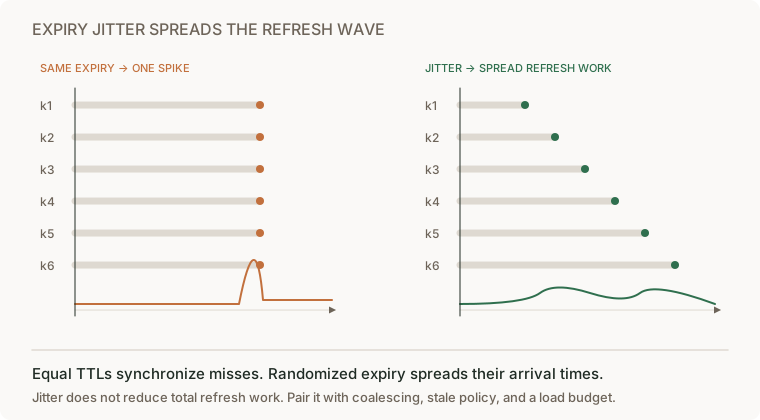
3 · Refreshing a page takes seconds
The reference sketch · compare after you have drawn yours

Break it: the worker writes a result and crashes before acknowledgement. Trace the redelivery. Mark the narrow effect your idempotency record protects.
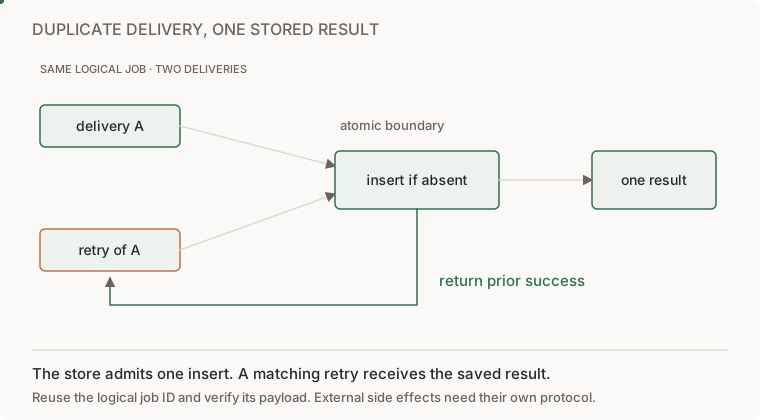
4 · A dependency becomes slow
The reference sketch · compare after you have drawn yours

Break it: both pools share the same database. Which failure can still cross your bulkhead?
Translate the boxes into AWS
| Mechanism | Candidate AWS implementation | Decision you must still make |
|---|---|---|
| HTTP entry | ALB with ECS, or API Gateway with Lambda | Runtime and scaling model |
| Durable application state | RDS/Aurora or DynamoDB | Query patterns, invariants, consistency |
| Shared cache | ElastiCache | Staleness, eviction, outage behavior |
| Durable work queue | SQS + DLQ | Visibility, retries, ordering, concurrency |
| Object bytes | S3 | Key ownership, lifecycle, upload validation |
| Telemetry | CloudWatch and tracing instrumentation | User outcome, sampling, actionable alerts |
These are candidate mappings, not a requirement to use every service. Follow the AWS labs for implementation and current primary references.
Interview rehearsal
- Draw the happy path in two minutes.
- Label the source of truth, trust boundaries, and resource limits.
- Draw a timeout, duplicate, and slow dependency in another color.
- Name the observable symptom and recovery action for each.
- Remove one box. Explain what worsens and what becomes simpler.
Junior: prove one request and one invariant. Senior: quantify limits and recovery. Staff: add ownership, migration, regional failure, and operational cost.