Weighted paths: expand the cheapest candidate
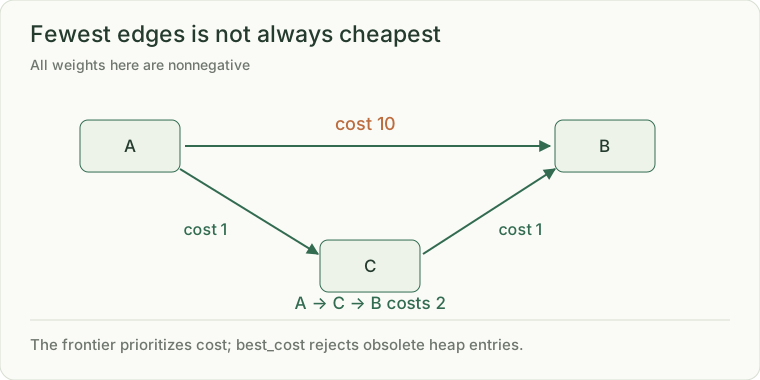
A delivery route goes directly from A to B at cost 10, or from A to C to B at costs 1 and 1. The two-hop route is cheaper. You will follow the candidate costs in a heap and see why visiting the fewest edges would answer the wrong question.
BFS minimizes the number of equal-cost edges. When edges have different costs, the route with fewer edges may cost more. For nonnegative weights, Dijkstra's algorithm expands the cheapest known candidate using a min-heap.
from heapq import heappop, heappush

graph = {"A": [("B", 10), ("C", 1)], "C": [("B", 1)], "B": []}
best_cost = {"A": 0}
frontier = [(0, "A")]
while frontier:
    cost, node = heappop(frontier)
    if cost != best_cost[node]:
        continue
    for neighbor, weight in graph[node]:
        candidate = cost + weight
        if candidate < best_cost.get(neighbor, float("inf")):
            best_cost[neighbor] = candidate
            heappush(frontier, (candidate, neighbor))
print(best_cost["B"])  # 2
The snippet assumes a complete adjacency mapping, nonnegative weights, and comparable string node IDs. For arbitrary objects, add a sequence number to heap entries so equal costs do not trigger object comparisons. The full problem validates its boundary.
Why stale entries are harmless
The direct route places (10, B) in the frontier. Going through C later discovers (2, B). The heap may hold both, but best_cost[B] is authoritative, so the old cost 10 is skipped when popped. A predecessor map can reconstruct the route; costs alone cannot.
With this lazy duplicate-entry heap, there can be O(E) queued candidates: O((V+E) log(1+E)) time is a safe bound and O(V+E) space. For a simple graph this is commonly written O((V+E) log V). State the representation used when quoting the bound.
Know which problem you have
| Edge costs | Starting algorithm | Limitation |
|---|---|---|
| Equal | BFS | Minimizes edge count |
| Nonnegative | Dijkstra | Negative edges invalidate the greedy proof |
| Negative allowed | Bellman–Ford or another suitable method | Detect reachable negative cycles; O(VE) for Bellman–Ford |
| Directed acyclic graph | Process a topological order | Requires acyclicity; O(V+E) relaxation |
An unreachable node has no finite distance. A negative cycle reachable from the source can make some shortest distances undefined. Those are contract outcomes, not a large made-up number.
Watch the cheaper route replace the estimate
| Removed candidate | New information | Pending candidates afterward |
|---|---|---|
| A at cost 0 | B can cost 10, C can cost 1 | C:1, B:10 |
| C at cost 1 | B improves to cost 2 | B:2, B:10 |
| B at cost 2 | Its best route is now processed | B:10 |
| B at cost 10 | Stored best is 2, so this entry is stale | none |
The table presents pending candidates in cost order for readability. A heap's internal array is not fully sorted. The authoritative best-cost map is what makes retaining an obsolete heap entry safe.