Cost: count the work and the memory
A report sums four transaction amounts. Another report compares every transaction with every other one. Both finish quickly with four rows, but their work grows differently when the file contains a million rows. You will count operations and retained values before using notation such as O(n). The goal is to explain growth, not predict seconds from a formula alone.
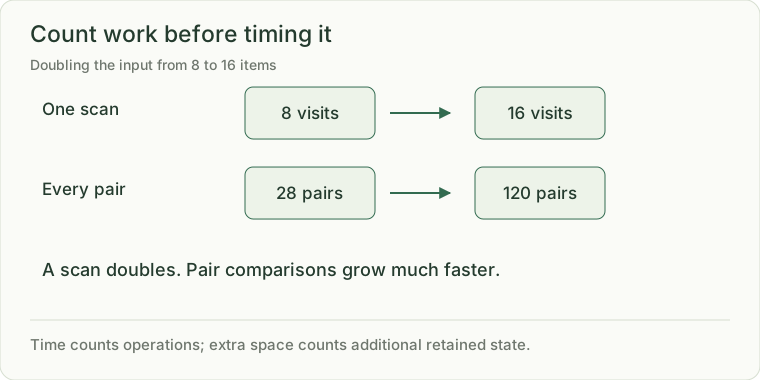
Before choosing a structure, ask what grows when the input doubles. Let n be the number of items. Time complexity describes how the work grows; extra space describes memory allocated in addition to the input. Neither is a stopwatch reading.
Start with something you can count
values = [4, 8, 12, 16]
total = 0
for value in values:
    total += value
print(total)  # 40
There are four additions for four values: O(n) time. total is one accumulator, so auxiliary space is O(1) under a fixed-size arithmetic model. Creating doubled = [2 * value for value in values] also takes O(n) time, but allocates n output values. Say whether your space bound includes the output.
Recognize the common growth patterns
| Bound | What the algorithm does | How the work grows |
|---|---|---|
| O(1) | One direct array access | Same number of accesses |
| O(log n) | Repeatedly halves a candidate range | Doubling n adds roughly one halving |
| O(n) | Visits each item once | Doubling n doubles the visits |
| O(n log n) | Typical comparison sorting | Doubling n takes a little more than twice the work |
| O(n²) | Compares every pair | Doubling n gives roughly four times the pairs |
| O(2ⁿ) | Enumerates all subsets | One extra item doubles the subsets |
O(n²) is an upper-bound growth statement. Nested loops are not automatically quadratic: if a left pointer advances at most n times across the entire outer loop, total pointer movement is O(n).
Three qualifiers matter
Worst case: the largest work for a given input size. Expected: an average under stated assumptions, such as well-distributed hash values. Amortized: total work spread across a sequence, such as occasional resizing during list appends. A Python dictionary lookup is normally described as expected O(1), and list append as amortized O(1).
Strings, slices, sorting, and recursive calls hide work too. Copying a length-k slice costs O(k); recursion retains a call stack; returning p answers costs at least O(p). Python integers grow, so arithmetic on enormous integers is not literally fixed cost.
Check your understanding
If a scan stores every distinct value, its time can be O(n) and its extra space O(n). If a recursive search reaches depth n, its stack can consume O(n) even when it allocates no explicit collection. Explain both bounds before calling a solution efficient.
Compare a scan with a pair search
| Input size | One visit per item | Distinct unordered pairs |
|---|---|---|
| 4 | 4 | 6 |
| 8 | 8 | 28 |
| 1,000 | 1,000 | 499,500 |
The pair count is n * (n - 1) / 2. Doubling a small input does not make the exact count precisely four times larger, but quadratic growth approaches that ratio as n grows. Now suppose the pair search stops at its first match. Its best run may finish immediately while its worst no-match run still examines every pair. State which case you are describing.
Sources: Python data structures · Algorithm analysis and fundamental structures