Reject excess API work before queues grow without bound
Application background
A subscription API handles customer writes, interactive reads and large exports. Its machines can finish only a limited amount of work each second. If twice that amount keeps arriving, letting everything wait merely builds a longer queue.
The application must decide which work may start, which may wait briefly and which must be rejected. Rejecting excess work early can preserve useful service for accepted requests and give callers a clear response.
Example walkthrough
01 · Try this input
- Input / starting state
- 40,000 requests arrive per second, but capacity is 20,000
- Expected result
- Do not promise that every request will finish.
02 · Try this input
- Input / starting state
- A bulk export arrives while interactive capacity is needed
- Expected result
- Apply the declared priority and rejection policy.
03 · Try this input
- Input / starting state
- Critical requests alone exceed capacity
- Expected result
- Reject some critical work too rather than growing memory without limit.
Load shedding means deliberately refusing work the service cannot complete within its limits. It needs a caller-visible response, not a hidden drop.
Your assignment
Deliver: Build request admission with finite waiting limits and explicit rejection responses. Apply the declared work priorities and demonstrate recovery when demand falls.
Required behavior: Admission is bounded by class and dependency capacity. Accepted work has a finite deadline. Rejected work returns a clear retryable or non-retryable outcome before expensive side effects begin.
The required first milestone is a working local implementation of the behavior above. The numbered implementation steps define the scope. The cloud architecture is a later extension, not something the starter has already provisioned.
Get the code and run the supplied example
The code is in the public junior-to-staff repository. Install Git and Python 3.12+. No AWS account or Python packages are required for this first run. If you already have a checkout, use it and skip cloning.
git clone https://github.com/Soulful-Iris/junior-to-staff.git
cd junior-to-staff
python3 examples/architecture-starts/overload_shedding.py
Supplied file: examples/architecture-starts/overload_shedding.py. You can also read or download the source here (download file, source below).
Read the supplied code · overload_shedding.py
"""Local mechanism demonstration for overload-shedding. No AWS resources are created."""
arrival=40000; service=20000; limit=100000; queued=0
for second in range(1,8):
    offered=queued+arrival; completed=min(service,offered)
    waiting=offered-completed; rejected=max(0,waiting-limit); queued=min(waiting,limit)
    print(second,'completed',completed,'queued',queued,'rejected',rejected)
This program is a mechanism demonstration: it runs the small scenario in one process and prints the result. It is not an HTTP service, a complete application, or an AWS deployment. A successful run demonstrates this mechanism only. It does not establish the workload or failure guarantees of the application you will build.
Example output from the supplied run:
Generated IDs and timestamps may differ. Compare the state transitions and outcomes.
1 completed 20000 queued 20000 rejected 0
2 completed 20000 queued 40000 rejected 0
3 completed 20000 queued 60000 rejected 0
4 completed 20000 queued 80000 rejected 0
… (more output follows)
Set up your implementation workspace
Create work/overload-shedding/ in your checkout (or use a separate repository). Copy the supplied mechanism into that directory as mechanism.py, then extract its state transitions into functions you can call from your implementation. The record and module names below describe what you must implement. They are not a promise that files with those names already exist. Keep a README.md beside your implementation with its exact run commands and observed results.
Local components and state to implement
This table names the records, interfaces or decision inputs for your deliverable. Unless a name is explicitly linked to supplied source above, it is something you create. Implement the local state transitions first, then connect the HTTP, storage or worker boundaries required by the steps.
| Record / module | Key or interface | Responsibility |
|---|---|---|
| admission_policy | request_class,rate,concurrency,deadline | Product priority and resource budget. |
| queue_state | class,depth,oldest_age | Bounded waiting and expiry. |
| outcomes | admitted,completed,rejected,expired | Honest accounting of work under pressure. |
Implement the assignment
1. Locate the constrained dependency
Measure completed throughput, active work and queue age as arrivals rise. Identify whether CPU, database connections or a downstream quota saturates. Adding API instances cannot create more capacity in a fixed database dependency.
2. Classify and admit early
Derive class from trusted route/account context. Reserve explicit budgets for critical work and reject excess before allocating expensive connections or starting external effects. Keep fairness within a paid class so one tenant cannot spend the entire reserve.
3. Bound waiting and retries
Cap queue length and maximum age, expire work that cannot finish before its deadline, and propagate cancellation. Return bounded Retry-After and document client retry budgets with jitter. Retrying rejected traffic at every service layer multiplies the original overload.
4. Recover without a second surge
Reduce concurrency when the dependency degrades and ramp it back gradually after recovery. Keep hysteresis between shedding and reopening. Report completed useful work and class-specific rejection, not merely a lower response latency caused by rejecting everything.
Demonstrate the completed local result
01 · Try this input
- Input / starting state
- Run the starting program
- Expected result
- The queue reaches 100,000 at five seconds, then rejects excess arrivals.
02 · Try this input
- Input / starting state
- Halve database capacity
- Expected result
- Admission shrinks and exposes the chosen within-class priorities.
03 · Try this input
- Input / starting state
- Restore the database
- Expected result
- Traffic ramps up without replaying the whole backlog at once.
Handoff: In your implementation README, include the start command, one successful operation, the failure case above and the resulting stored state or decision. State which dependencies are simulated. Someone with a fresh checkout should be able to reproduce this without your chat history.
Workload assumptions and capacity decisions
These are constructed exercise assumptions. The stated workload is a design target. The local demonstration does not establish that throughput. Use the estimation constants to check units before choosing capacity.
| Input or objective | Calculation / consequence |
|---|---|
| 40,000 arrivals/s. 20,000 completions/s | Backlog grows 20,000/s. A 100,000-request queue fills in five seconds. |
| 12,000 paid writes/s plus 8,000 reads/s desired allocation | At full healthy capacity those consume the entire budget. Bulk work needs a separate or deferred share. |
| Database capacity halves to 10,000/s | The original paid-write promise no longer fits. Define explicit priority and rejection within that class. |
Map the local implementation to AWS
Deployment status: local only. Running the supplied command creates no AWS resources and configures no cloud connections. The diagram is a proposed deployment of the completed application. Each box needs either a deployed runtime, a provisioned service or an explicitly external dependency.
Read the diagram by following the arrows from the entry point: application code accepts the request or event, the state owner commits it, and any worker produces the later result. The table ties those roles to code and adapter work. Multiple boxes do not imply multiple Python files already exist.
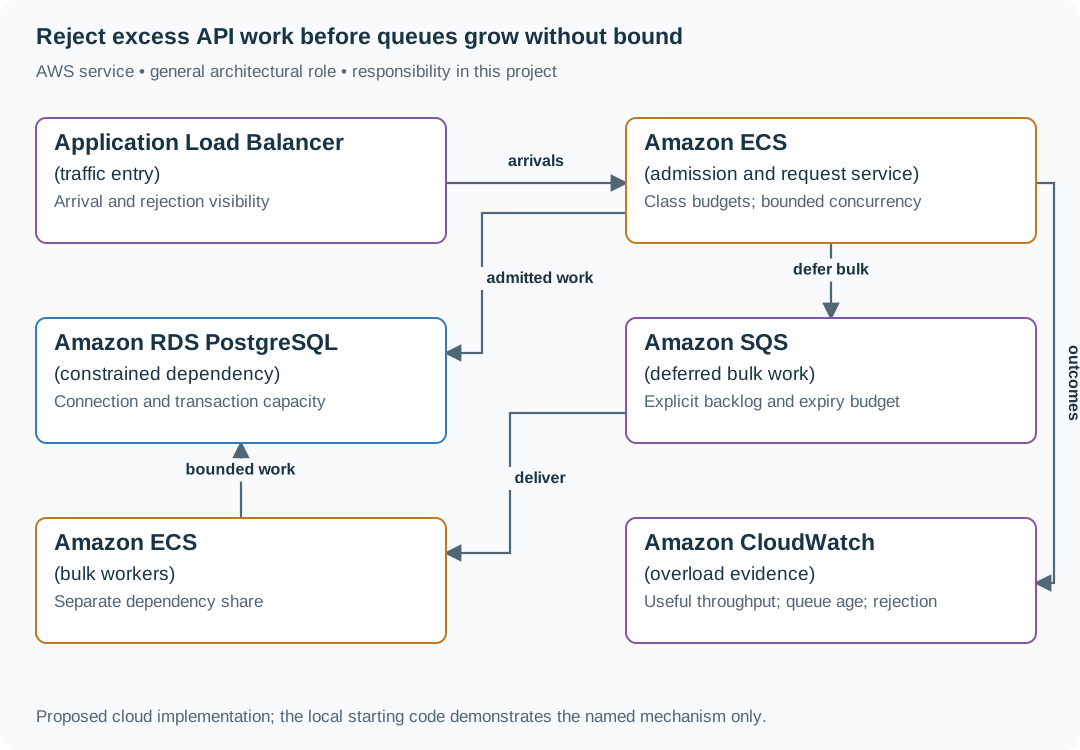
Admission protects the scarce dependency. SQS is suitable for explicitly deferred work, but it cannot turn an unbounded interactive wait into a successful user experience.
| Local responsibility | Cloud destination and role | Implementation still required |
|---|---|---|
| Local HTTP listener | Application Load Balancer: traffic entry | Deploy a service behind a target group, configure health checks and bounded connection/request behavior. |
| Application or worker process | Amazon ECS: admission and request service | Build a container and task definition. Supply configuration, task roles and graceful shutdown behavior. |
| Local records and transaction boundary | Amazon RDS PostgreSQL: constrained dependency | Write PostgreSQL schema/migrations and a database adapter. Configure credentials, connection limits and recovery. |
| Local pending-work collection | Amazon SQS: deferred bulk work | Publish committed job intent, consume messages and persist deduplication/ownership state. Add visibility, retry and dead-letter handling. |
| Application or worker process | Amazon ECS: bulk workers | Build a container and task definition. Supply configuration, task roles and graceful shutdown behavior. |
| Local counters, timestamps and diagnostic output | Amazon CloudWatch: overload evidence | Emit bounded metrics and logs, build the named operational view and configure retention and access. |
Provision resources, then connect the application
| Resource or boundary | Initial configuration and reason |
|---|---|
| Application limits | Set per-class concurrency, queue size and deadline independently of autoscaling. |
| Database pools | Sum all API and worker pools against one dependency budget. Reserve emergency operating headroom. |
| Scaling | Scale only while useful throughput improves. Bounded admission remains active during scale-up and dependency failure. |
Use one disposable AWS environment for the cloud exercise. Put the named resources in infra/template.yaml or your existing IaC tool, pass resource IDs through configuration, and scope each runtime role to its own tables, buckets and queues. The diagram is a design to implement. It is not a claim that these resources have been deployed. Record the commands you used to deploy and remove the exercise resources.
For concrete provisioning commands, configuration wiring and cleanup, use the AWS foundation guide. It includes a deployable table/queue/object-storage foundation and explains which application and service adapters you still implement.
A provisioned queue or table does not make the local program use it. Configure resource IDs in the deployed runtime, replace the local adapter, and replay the same successful and failing operation against that runtime. Record the deployed commit and observable result, then remove the disposable resources using your infrastructure tool.
Extend the design after the baseline works
Worked follow-up: Allocate scarce database work across competing products
Priority labels cannot create connections or CPU. A cheap read and an expensive export also should not consume the same unit of budget merely because each is one HTTP request.
| Starting design | Changed requirement |
|---|---|
| Routes are marked critical or optional. | Every product claims priority but their combined work exceeds database capacity. |
Revised architecture. Follow the changed responsibility and failure path below. This is a design to implement. The supplied local example does not provision these components.

What to implement. Measure approximate database work per operation and reserve a small control/recovery share. Give each product a minimum allocation plus bounded borrowing from unused capacity. Enforce total active work at a shared admission boundary, then use separate queues or worker pools for exports and interactive requests. Expire queued work that can no longer meet its user deadline. Keep durable business obligations visible for later reconciliation.
Walk through the result. Use an illustrative budget of 100 work units/s. Saves cost one unit and exports cost 100. One export must not consume an unbounded slot alongside 100 supposedly admitted saves. Show the chosen allocation, denied work and recovery reserve during a 60-second overload. Deliver absolute rates as well as percentages.
Product labels every route critical. Use dependency consumption and user consequences to produce an allocation that fits actual capacity. A label cannot reserve resources that do not exist.
Additional design cases, alternatives and original source notes
Your contract. Keep paid writes available where capacity permits. Shed work early with a stable policy. Reserve enough capacity for health and recovery. Define an admission signal that does not wait for every caller to time out. Constructed scenario and workload.
01 · Try this input
- Input / starting state
- 12k/s paid writes, 8k/s free reads
- Expected result
- Accept within measured safe capacity. Report tail latency by class
02 · Try this input
- Input / starting state
- Free reads spike to 30k/s
- Expected result
- Shed or cache free reads before they starve paid writes
03 · Try this input
- Input / starting state
- Database slows to half capacity
- Expected result
- Reduce admission, expose 429/503 with bounded retry guidance
04 · Try this input
- Input / starting state
- Every client retries after 1 second
- Expected result
- Jitter/backoff and budgets prevent retry traffic from multiplying overload
Calculate the queue before choosing an autoscaler
At 40k/s arriving and 20k/s service capacity, backlog grows by 20k requests per second if admission does nothing. A 100k-request buffer fills in five seconds. A bigger queue raises latency rather than increasing throughput. Reserve per-class concurrency and cap queue waiting against each deadline. Shed low-priority work at the gateway, set a retry budget with randomized backoff, and measure accepted work, dropped work, p99, and recovery time. Autoscaling cannot instantly repair a constrained database or hot key.
| AWS box | Job here | Alternative and deciding factor |
|---|---|---|
| Amazon API Gateway (edge admission) | Reject coarse excess early and authenticate clients | Application Load Balancer plus app-owned prioritization for finer classes |
| Amazon ElastiCache (cache) | Serve safe repeatable reads without hitting the database | CloudFront (CDN) for public cacheable content nearer users |
| Amazon ECS (application compute) | Implement per-class concurrency limits, deadlines, and shedding | AWS Lambda with reserved concurrency if request shape and saturation permit |
| Amazon RDS (database) | Own durable writes. Monitor its real service capacity | Amazon DynamoDB for key-value access patterns and a compatible model |
| Amazon CloudWatch (telemetry) | Observe queue age, p99 by class, and rejected work | Existing tracing/metrics system with same per-class evidence |
A cache is only a substitute for database reads that may legally be stale. API Gateway throttling alone does not encode the business priorities. The service still needs admission budgets. State what you shed and what you never drop.
Senior follow-up: Health checks succeed while users time out. Build an overload signal from useful work and queue delay. Show a 60-second incident trace.
Staff follow-up: Three products share a data tier. Set per-tenant and per-product budgets, equitable borrowing, and a governance process for changing priority without silently starving a smaller customer.
Practice artifact: Compute backlog under three loads, draw priority lanes and degradation response, then describe how to test shedding safely under a load ramp.
Source boundary: Original scenario. Meta's September 2026 shared proxy account discusses overload protection. The AWS Builders' Library on retries describes retry amplification. Neither is an interview-question report.