Implement replicated writes and fenced leadership
Application background
An application sends a key and value to a storage service, then reads the value back later. To keep data available after a machine fails, the service stores copies on several machines. One machine, the leader, coordinates writes.
The critical question is when the leader may reply Saved. If it replies before enough copies are safe, its failure can erase a write the application believes succeeded. An old leader returning later must not overwrite the new leader's work.
Example walkthrough
01 · Try this input
- Input / starting state
- The application writes
cart:7 = ready - Expected result
- Acknowledge only after the declared durability condition holds.
02 · Try this input
- Input / starting state
- The leader stops
- Expected result
- Choose a replacement that preserves acknowledged writes.
03 · Try this input
- Input / starting state
- The old leader returns
- Expected result
- Reject writes carrying its older leadership term.
A term is a numbered period of leadership. A replicated log is the ordered sequence of changes copied between machines. The exercise makes these rules visible before attempting a full storage service.
Your assignment
Deliver: Build a small storage service with a durable local log, then extend it to separate replica processes under the declared protocol. Demonstrate leader failure without losing writes acknowledged under that protocol.
Required behavior: PUT /keys/{key} accepts a request identity and optional expected version. GET exposes a chosen consistency mode. The first milestone is one durable local log. The replicated milestone uses a specified consensus protocol with durable terms and a committed-log rule.
The required first milestone is a working local implementation of the behavior above. The numbered implementation steps define the scope. The cloud architecture is a later extension, not something the starter has already provisioned.
Get the code and run the supplied example
The code is in the public junior-to-staff repository. Install Git and Python 3.12+. No AWS account or Python packages are required for this first run. If you already have a checkout, use it and skip cloning.
git clone https://github.com/Soulful-Iris/junior-to-staff.git
cd junior-to-staff
python3 examples/architecture-starts/distributed_key_value_store.py
Supplied file: examples/architecture-starts/distributed_key_value_store.py. You can also read or download the source here (download file, source below).
Read the supplied code · distributed_key_value_store.py
"""Local mechanism demonstration for distributed-key-value-store. No AWS resources are created."""
import json,os,tempfile
with tempfile.TemporaryDirectory() as directory:
    path=directory+'/wal.jsonl'
    with open(path,'w') as log:
        log.write(json.dumps({'index':1,'term':3,'key':'a','value':'saved'})+'\n')
        log.flush(); os.fsync(log.fileno())
    recovered={}
    with open(path) as log:
        for line in log:
            entry=json.loads(line); recovered[entry['key']]=entry['value']
    print('Recovered after closing the writer:',recovered)
print('Local WAL only: this is not a replicated consensus implementation.')
This program is a mechanism demonstration: it runs the small scenario in one process and prints the result. It is not an HTTP service, a complete application, or an AWS deployment. A successful run demonstrates this mechanism only. It does not establish the workload or failure guarantees of the application you will build.
Example output from the supplied run:
Generated IDs and timestamps may differ. Compare the state transitions and outcomes.
Recovered after closing the writer: {'a': 'saved'}
Local WAL only: this is not a replicated consensus implementation.
Set up your implementation workspace
Create work/distributed-key-value-store/ in your checkout (or use a separate repository). Copy the supplied mechanism into that directory as mechanism.py, then extract its state transitions into functions you can call from your implementation. The record and module names below describe what you must implement. They are not a promise that files with those names already exist. Keep a README.md beside your implementation with its exact run commands and observed results.
Local components and state to implement
This table names the records, interfaces or decision inputs for your deliverable. Unless a name is explicitly linked to supplied source above, it is something you create. Implement the local state transitions first, then connect the HTTP, storage or worker boundaries required by the steps.
| Record / module | Key or interface | Responsibility |
|---|---|---|
| log_entries | partition,index,term,request_id,command | Durable ordered commands before state application. |
| replica_state | current_term,voted_for,commit_index | Persisted protocol state with explicit recovery rules. |
| key_state | key,value,version | Materialized committed log. Snapshots include last applied index. |
Implement the assignment
1. Make one node recoverable
Append length/checksummed records, flush according to the acknowledgement policy and replay committed records on restart. Handle a truncated final record explicitly. Add snapshots with a last included index, and retain log segments until snapshot durability is established.
2. Specify replication before adding nodes
Use a documented Raft implementation or implement its full term, election, log-matching and commitment rules as the learning objective. A leader sends ordered entries, followers durably record them, and success waits for the required committed majority. Never treat two arbitrary copies as proof of the protocol.
3. Define read and retry semantics
Deduplicate client operations at the replicated state-machine boundary. Linearizable reads require proof of current leadership and applied commit position. Follower reads may be stale and must be labeled as such. Conditional writes compare the committed key version.
4. Partition and rebalance deliberately
Route keys to versioned partition ownership. Move snapshots plus log tails, then transfer authority under a fenced configuration change. Measure the hottest partition and replication cost before deriving node count from average operations.
Demonstrate the completed local result
01 · Try this input
- Input / starting state
- Run the starting program
- Expected result
- The value is recovered from the flushed local log.
02 · Try this input
- Input / starting state
- Kill the replicated leader after acknowledgement
- Expected result
- The new leader retains every acknowledged command under the chosen protocol.
03 · Try this input
- Input / starting state
- Resume the old leader
- Expected result
- Its stale term cannot commit writes.
Handoff: In your implementation README, include the start command, one successful operation, the failure case above and the resulting stored state or decision. State which dependencies are simulated. Someone with a fresh checkout should be able to reproduce this without your chat history.
Workload assumptions and capacity decisions
These are constructed exercise assumptions. The stated workload is a design target. The local demonstration does not establish that throughput. Use the estimation constants to check units before choosing capacity.
| Input or objective | Calculation / consequence |
|---|---|
| Two million operations/s target. 300 nodes | About 6,667 operations/s/node average before replication and skew. The local starter makes no throughput claim. |
| Three replicas per partition | A majority is two, but quorum arithmetic alone does not define leader election, log recovery or linearizable reads. |
| 99.99% availability objective | Roughly 4.32 minutes unavailable in a 30-day month. Define which failed/slow requests count. |
Map the local implementation to AWS
Deployment status: local only. Running the supplied command creates no AWS resources and configures no cloud connections. The diagram is a proposed deployment of the completed application. Each box needs either a deployed runtime, a provisioned service or an explicitly external dependency.
Read the diagram by following the arrows from the entry point: application code accepts the request or event, the state owner commits it, and any worker produces the later result. The table ties those roles to code and adapter work. Multiple boxes do not imply multiple Python files already exist.
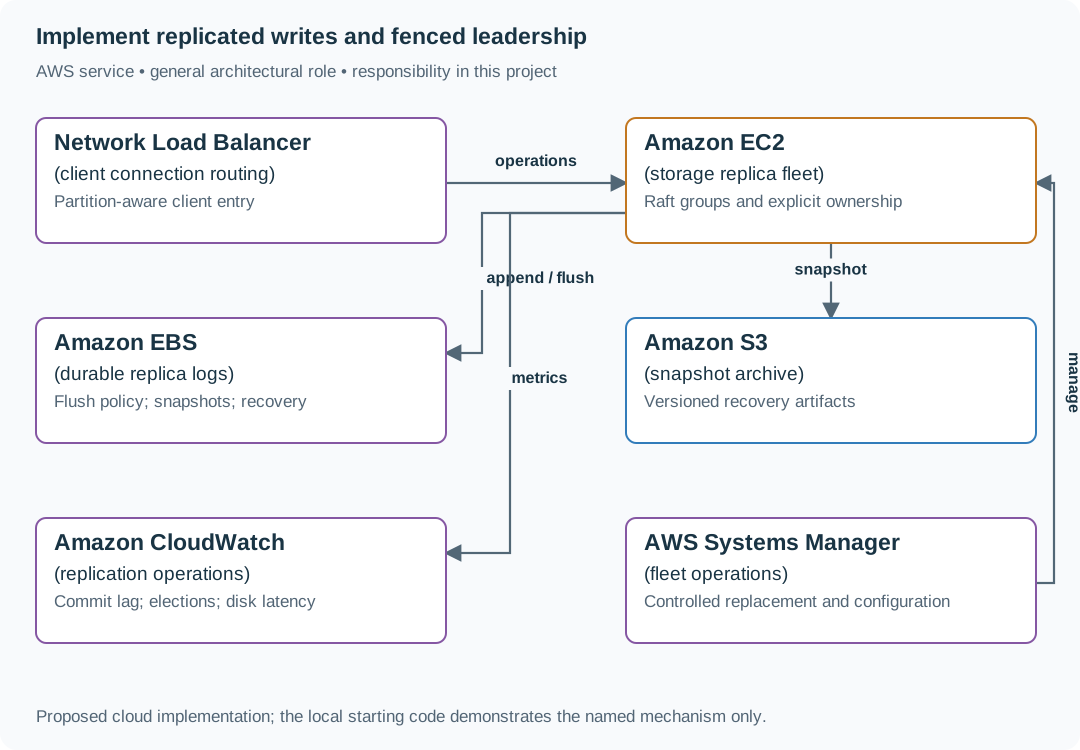
This project intentionally uses EC2/EBS because building the storage mechanism is the assignment. DynamoDB is the practical alternative when the goal is to use a durable key-value service rather than implement one.
| Local responsibility | Cloud destination and role | Implementation still required |
|---|---|---|
| Local process connection boundary | Network Load Balancer: client connection routing | Register deployed replicas and configure listener, reachability and health behavior. |
| Local process or worker model | Amazon EC2: storage replica fleet | Provision isolated hosts, package the runtime and implement lifecycle/resource limits. A local simulation is not a hostile-code sandbox. |
| Local on-disk log | Amazon EBS: durable replica logs | Attach persistent volumes and implement durable writes/recovery. Volume persistence does not establish replicated consensus. |
| Local file, object fixture or exported payload | Amazon S3: snapshot archive | Implement upload/download and metadata adapters, scoped access, object naming, retention and incomplete-upload cleanup. |
| Local counters, timestamps and diagnostic output | Amazon CloudWatch: replication operations | Emit bounded metrics and logs, build the named operational view and configure retention and access. |
| Manual operational commands | AWS Systems Manager: fleet operations | Package scoped run procedures and record execution results. Validate the recovery procedure against actual stored state. |
Provision resources, then connect the application
| Resource or boundary | Initial configuration and reason |
|---|---|
| Replica placement | Put a partition’s replicas in distinct AZs and state which correlated failures the design tolerates. |
| Storage | Benchmark durable flush latency and recovery time. Local process success is not proof of replicated durability. |
| Membership | Use the consensus implementation’s safe reconfiguration mechanism. Do not replace a majority simultaneously. |
Use one disposable AWS environment for the cloud exercise. Put the named resources in infra/template.yaml or your existing IaC tool, pass resource IDs through configuration, and scope each runtime role to its own tables, buckets and queues. The diagram is a design to implement. It is not a claim that these resources have been deployed. Record the commands you used to deploy and remove the exercise resources.
For concrete provisioning commands, configuration wiring and cleanup, use the AWS foundation guide. It includes a deployable table/queue/object-storage foundation and explains which application and service adapters you still implement.
A provisioned queue or table does not make the local program use it. Configure resource IDs in the deployed runtime, replace the local adapter, and replay the same successful and failing operation against that runtime. Record the deployed commit and observable result, then remove the disposable resources using your infrastructure tool.
Extend the design after the baseline works
Worked follow-up: Choose a cross-region replication protocol explicitly
Adding replica icons on a map does not define consistency. Quorum overlap alone is insufficient without version ordering, concurrent-write rules and the required read/write protocol.
| Starting design | Changed requirement |
|---|---|
| A replica group operates within one region. | The store must explain write acknowledgement and recovery across a regional partition. |
Revised architecture. Follow the changed responsibility and failure path below. This is a design to implement. The supplied local example does not provision these components.

What to implement. For this extension, choose a consensus-led group with one leader and a durable majority acknowledgement. Place replicas across three failure domains and state which regional loss leaves a majority. Minority partitions refuse writes. Reads requiring the latest value must use the protocol's authoritative read path. Budget repair separately from foreground traffic. This is a storage-protocol design exercise, not a claim that a managed AWS database exposes these exact internal controls.
Walk through the result. With one voting replica in each of A, B and C, disconnect A. Show B and C retaining a majority and A refusing writes. Then leave only B reachable and show writes unavailable. Explain the remote round-trip cost and what happens to an unacknowledged write from the old leader. Deliver the leader epoch and acknowledgement trace.
Add multi-region replicas. Quantify the write-latency cost of cross-region quorum and state the availability behavior under partition. Do not promise both independent regional writes and single-copy semantics without a protocol that actually provides them.
Additional design cases, alternatives and original source notes
This is a commonly listed system-design interview prompt with a concrete practice contract. Assume 2 million operations/s, 99.99% monthly availability and keys partitioned across 300 storage nodes. Clarify service guarantees and a first version before filling the board with services.
01 · Try this input
- Input / starting state
- Read after write
- Expected result
- Return v8 under the stated consistency contract.
Input / condition: Client puts v8 then reads from another node
02 · Try this input
- Input / starting state
- One replica down
- Expected result
- Define quorum and whether a write may be acknowledged.
Input / condition: Two of three replicas are healthy
03 · Try this input
- Input / starting state
- Large object
- Expected result
- Store bytes separately. Keep metadata and chunk manifest in KV path.
Input / condition: Value is 2 GB
04 · Try this input
- Input / starting state
- Tombstone expires
- Expected result
- Retention/repair protocol prevents resurrection.
Input / condition: Old replica returns deleted value
Think from the contract to the boxes
Choose partitioning and replication before naming a database. A write has a version, replica quorum and durability promise. Read-your-writes can use session tokens or quorum reads. Deletes need tombstones long enough to reach every replica. Compaction cannot erase the only evidence too early. Large values move through object storage with checksummed manifests. Distinguish acknowledgment latency from repair convergence.
First diagram: Draw hash partition → replica set → quorum response, then show hinted handoff/repair and tombstone propagation.
| AWS service / general role | Why it fits this design | Alternative and when it fits better |
|---|---|---|
| Amazon DynamoDB / managed key-value store | Choose for managed key access patterns and conditional writes. | Amazon Keyspaces for Cassandra-compatible wide-column workload. |
| Amazon S3 / large-value object store | Keep multi-GB payload bytes outside the hot metadata path. | EBS only for attached block storage, not shared object access. |
| Amazon Route 53 / client endpoint routing | Resolve regional/service endpoints. | AWS Global Accelerator for static anycast ingress. |
| Amazon CloudWatch / replica health telemetry | Track write latency, throttles, replication lag and repair backlog. | OpenTelemetry metrics where custom replica internals matter. |
| AWS Backup / recovery copies | Create point-in-time recovery protection for supported resources. | Application export snapshots for cross-engine recovery needs. |
Service choice follows the contract: the box label gives the generic job, while the table explains the AWS product and a reasonable substitute. Name which component owns durable truth, where retries happen, and the guarantee each managed service does not provide by itself.
Pressure-test the design
Follow-up: An acknowledged write is absent on one replica. Draw quorum intersection, read repair, and why expiring a tombstone too early resurrects a deleted key.
A rack loss causes repair traffic to compete with foreground reads. Set repair bandwidth, admission priority, and degraded-mode consistency behavior.
Offer this store to teams with different data models. Define API/version contracts, isolation, migrations and when to use a managed database instead of operating a new distributed store.
Practice artifact: Draw hash partition → replica set → quorum response, then show hinted handoff/repair and tombstone propagation. Then trace every row in the table, draw one failure, and state what the customer observes. Suggested rehearsal: 35 minutes design, 10 minutes to challenge the guarantees.
Evidence and origin: The current community interview-question catalog lists a distributed key-value store prompt at LinkedIn, Databricks, Geico and Microsoft. Individual report dates are not listed. The entry does not show the interview date and is not a verified company rubric. The prompt contract, workload, outcomes, diagrams and solution here are original practice material. Treat company tags as reported sightings, not a prediction of your interview loop.
Interview report listing: Open the community question entry.