Turn recurring constraints into a usable technical strategy
Five teams deploy five different kinds of services. Operations supports five release paths, but four services have similar HTTP workloads and one runs long batch jobs. The organization wants less duplicated maintenance without forcing the batch service into an unsuitable runtime.
You will derive a supported default, define the exception boundary, and choose an adoption sequence. The result should help a sixth team make a concrete decision rather than merely announce a preferred technology.
Project connection · feeds Reading-list stage 5: evolve the running application
Write a rule the next team can use
An example policy is: “Stateless HTTP services that fit the documented request duration, networking and runtime requirements use the supported deployment path. Long-running jobs use the separately owned worker path. A new requirement outside either contract gets a measured design review.”
The missing detail matters. Define those duration and networking requirements from the actual platform, rather than leaving “ordinary service” to interpretation. Bring one HTTP request and one twenty-minute batch job to the review. Show where each runs, who supports it and how it is recovered. A roadmap then schedules the work needed to make that policy true.
Reason through the changed situation
“Five teams repeatedly choose different solutions for the same service needs. Operations now maintains five deployment paths. Should we standardize? Show the rule that makes the next team's decision easier without blocking a genuinely different workload.”
Technical strategy is a set of decisions that guides future work. A roadmap lists work; strategy explains why that work is the useful direction.
| Teaching observation | Expected decision evidence |
|---|---|
| Five deployment paths | Measured support effort and distinct requirements |
| Four ordinary HTTP services | A supported default if requirements align |
| One long-running specialized workload | An explicit evaluated exception |
| New services continue appearing | A discoverable decision rule and owner |

Derive a useful default
- Collect repeated decisions and failures before choosing a platform. Count actual maintenance and onboarding costs rather than aesthetic inconsistency.
- Separate common constraints from genuine exceptions. Define a default for the common case with a reason someone can challenge.
- Pilot one existing service, including migration and rollback. A blank demo does not reveal adoption friction.
- Measure whether teams can ship and operate more independently. Revisit a default when its assumptions change; exceptions need evidence and an owner.
“The specialized team cannot meet its latency goal on the default.” Add an exception route with a support contract instead of silently forcing it in.

Lead depth is the rule, migration sequence, ownership, and feedback mechanism. The number of teams adopting a tool is insufficient if their delivery worsens.
Diagnosis → choices → coordinated action
A technical strategy connects a diagnosed constraint to a small set of guiding choices and coherent actions. Insight can come from repeated decisions, anticipated scale, a product direction, a contractual deadline or a new threat. The origin does not substitute for evidence.
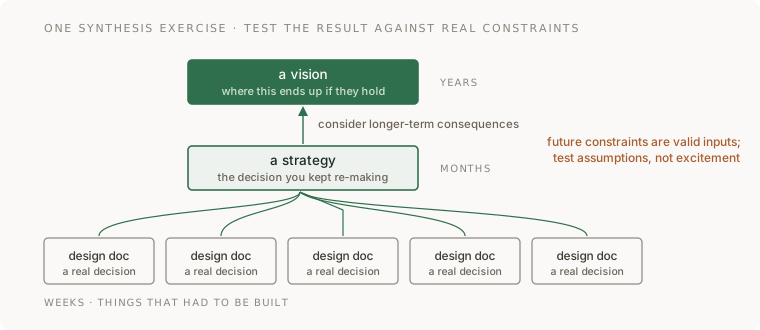
Reading several old design documents is one useful synthesis exercise, not a prerequisite. Five unrelated documents do not automatically make a strategy, and a future constraint can justify action before any such documents exist.
Worked example: a second operating region
The product will need a second region. Assume, for this exercise, that existing writers and recovery procedures are tied to one region.
| Strategy element | Concrete choice |
|---|---|
| Diagnosis | A regional outage currently leaves no exercised write-recovery path |
| Guiding policy | Establish one fenced write authority; replicas alone are not a failover protocol |
| Actions | Identify writers, define recovery objectives, rehearse authority transfer, measure data loss and restore time |
| Non-investment | Do not add active-active writes before their conflict contract is justified |
| Ownership | Named service owners and a coordinator for cross-service recovery |
| Revisit | Failed rehearsal, changed availability requirement or a scheduled review |
This may be justified by a future requirement even with no historical debate. Conversely, “standardize on database X” is not enough without explaining the constraint, adoption work, exceptions and expected result.
Make the default useful, not absolute
A shared platform has operating and migration costs. State which workloads fit, what support it provides and how a team can request a measured exception. An exception needs an owner; the default needs a maintainer. Adoption counts alone do not prove improved delivery or reliability.
Compare before and after using matched workloads and explicit outcomes. A policy can reduce one risk while increasing another. Record opportunity cost and uncertainty rather than manufacturing a loser just to demonstrate “trade-offs.”
Practice and acceptance
Start with either a recurring decision from P1–P4 or a justified future constraint. Write a short diagnosis, policy, actions, exclusions, owners and review trigger. Ask someone to apply it to a new design and to one legitimate exception. Ambiguous answers identify missing scope, not a need for more slogans.
A sound review may approve the strategy unchanged. A plain vision can be ambitious or unsurprising; excitement and boredom are not correctness tests.
Words to keep: diagnosis identifies the constraint; policy guides choices; actions make it operational; vision describes a desired future; review trigger states when to reconsider. A roadmap schedules work; it does not by itself explain why that work addresses the constraint.
Write a design document that supports a decision · Engineering effectiveness
Draw it from memory · Make strategy a constraint on real decisions

Name a supported case and a case outside this policy’s scope. Explain which constraint separates them.