Split a tagging feature into runnable changes
Application background
Adding tags to a reading list can touch database fields, input validation, API responses and browser controls. Putting all of it into one large change makes it difficult for a reviewer to see which part causes a behavior change.
You will implement the same feature in smaller, ordered steps while keeping the application runnable between them. The order matters because a browser cannot use a new response field before the API provides it.
Example walkthrough
| Action | Expected behavior |
|---|---|
| Add storage that the old application can still use | Keep existing save/list behavior working. |
| Add validation and the supported API response | Make the new behavior available to callers. |
| Update the UI to use it | Complete the feature without an intermediate broken caller. |
A change stack is a sequence of dependent changes. Each step should have one understandable purpose and a clear relationship to the next.
Your assignment
Deliver: Implement one tagging feature as both a large change and an ordered series of small changes with identical final behavior.
This is a constructed development-workflow exercise. Your output is the artifact named above and the observed comparison, rather than a production platform.
Get the starting application and prepare your workspace
The repository includes a small reading-list HTTP API with SQLite storage. Follow the setup and request walkthrough to save a URL and read it back before changing anything. The API has no tag endpoint, browser UI or production authentication yet.
git clone https://github.com/Soulful-Iris/junior-to-staff.git
cd junior-to-staff
python3 examples/reading-list-starter/app.py --db /tmp/reading-list.sqlite3
Leave the server running while sending the documented requests in a second terminal. Use a separate working copy for the exercise. Any helper, specification, review command or Git branches named below are artifacts you create, not hidden supplied solutions.
Complete the exercise
-
Start from your reading-list application, including a UI if you have completed Stage 1. If you only have the supplied API, build the small save/list UI first or explicitly limit this exercise to API layers.
-
Write the dependency order for rename, nullable schema, validation, API response and UI use. Implement the feature on one branch, then reconstruct it as separately runnable changes on a second branch.
-
Run the application after each layer and record what is usable. Compare final trees and behavior. Explain the failure when a caller expects the new API before it exists.
Demonstrate the result
01 · Small example
- Input / starting state
- Rename → nullable tags column → validation → API behavior → UI, all from the same base.
- Expected result
- All five stage tips build. The top matches the single-change implementation and seeded bugs have cited findings.
02 · Boundary / failure
- Input / starting state
- The UI stage lands before the response includes tags.
- Expected result
- A contract check rejects that stage. A smaller diff is not automatically a safe diff.
03 · Scope
- Input / starting state
- One feature. Compare identical behavior and preserve reviewer blinding.
- Expected result
- Explain any additional assumption before implementing it.
Keep the exact input, observed output and before/after artifact in your exercise README. Label constructed fixtures as fixtures. A fresh reader should be able to repeat the comparison without your conversation history.
Deployment scope
This assignment concerns local development evidence and workflow. AWS deployment is not required and no cloud resources are supplied or created. CI-policy exercises belong in a disposable repository. They do not change this guide's publish-on-main behavior. For a later application deployment, the starter's local-to-AWS mapping explains the missing adapters.
Additional reasoning and harder requirements
Study the failure, follow-up requirements and implementation prompts

Review time mixes mechanical changes with decisions. The counterexample is a tiny UI diff that depends on an absent API field: size alone cannot choose the order.
Reveal the approach and decisions
Write the dependency graph before splitting by file count. Add compatible schema before consumers. Keep mechanical changes separate. The invariant is deployable behavior at each stop, with an explainable final-tree comparison. Score correctly found defects rather than speed alone.
Follow-up 1 · The work stops halfway
Funding disappears after the schema stage. Can that stage remain deployed for a month?
Worked design and implementation
Use an additive nullable field or a safe default while existing readers remain compatible. Defer deleting or requiring the field. Verify both the old reader and old writer against the new schema.
Make the intermediate state a supported state. Add the new nullable field or safe default without requiring new callers to use it yet. Keep old reads and writes meaningful for the month the project may pause. Defer destructive cleanup. Assign an owner to the temporarily expanded schema.
Show the old client creating and reading a record after only the schema stage is deployed. Report whether it preserves unknown fields during updates. The deliverable is a stage compatibility table and a clear condition for retiring the old representation.
Follow-up 2 · A lower stage changes
Review changes the validation API after the UI branch already exists. Which checks become stale?
Worked design and implementation
Rebase dependent layers and rerun their integration checks against the revised base. Reuse artifacts only when their input commit is unchanged. Do not transfer a green result across a new dependency graph.
Track dependency identity through the stack. The API stage now depends on a revised validation commit, and the UI depends on that API result. Rebase or merge the new base into dependent stages, then repeat the relevant integration demonstration. A result from the old combined tree is stale.
Show the before/after commit graph and identify exactly which artifacts can still be reused because their inputs are unchanged. Keep this focused on the sample change stack rather than adding mandatory gates to this guide's publishing workflow.
Record the evidence and limitations
Build in three stops: reproduce the small case and baseline failure. Implement the protected boundary. Then replay both changed requirements with captured outputs. Record commands, fixtures, and observed results in your implementation README. A diagram is a prediction until those checks run.
Demonstrate checkout-and-run at every stage and a blind defect review. Additional lead scope: Budget review dependencies and define who maintains abandoned stages. Completion demonstrates practice evidence. It does not establish interview readiness or multi-team delivery experience.
Detailed implementation and AI-assisted prompts
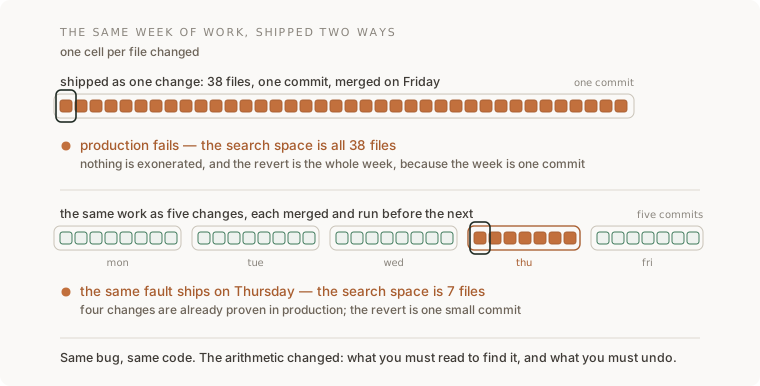
You end up with one feature built as a single 40-file pull request and again as a stack of five, and numbers for what review actually caught in each.
Build
One real Stage 1 reading-list feature — tagging is the right size: a rename, a migration, behaviour, UI — built twice from one plan: as a single PR, and as a stack of five layers, each green and runnable alone. Two bugs planted blind in both at the same spots. Review both forms, timed. Open the sealed answers last.
The thought process
The first decision is where the cut lines go, and it is a dependency question before it is a size question. The order that works: mechanical rename first (behaviour identical, tests untouched), schema next (harmless while nothing consumes it), then behaviour, then wiring. A cut passes two tests: the layer can be stated without "and", and main is still runnable if the stack stops here forever — stacks do get abandoned, and every layer must be a safe place to stop.
Second: what to measure. Minutes-to-review is gameable, and reviewers game it unconsciously. The honest instrument is the planted bugs, which is why they are planted blind: if you know where they are, you are measuring memory, not review.
How to organise the prompts
1. The stack plan, before any code:
Here is the feature: <one sentence>. Split it into a stack of at most
five layers. For each: one line of what, what it depends on, and why
main is still runnable if the stack stops here. Renames and refactors
get their own layer.
No layer may need "and". Every stop-here claim must be plausible. The plan is the project — argue with it before anything is built.
2. The blob.
Build the whole feature from that plan on one branch, tests included,
and open it as a single pull request.
Green suite. This is the control.
3. The stack.
Now build the same feature as the planned stack, one branch per layer,
each branched from the last. After each layer, run the suite and stop
so I can check before you continue.
At each stop: check out the layer, run it, describe the diff in one sentence.
At the top, git diff against the blob tip — empty, or every difference
explained.
4. The planting, in a separate session:
Here are two branches containing the same change. Plant the same two
subtle bugs in both — one inverted condition, one off-by-one — at the
same logical spots. Write the locations to sealed.txt and do not show
me its contents.
Review both forms — the section's first-pass prompt plus your own full read —
recording minutes and findings. Open sealed.txt only when both are done.
On AWS
"Each layer leaves main runnable" is a claim you can demonstrate instead of assert: give every PR a preview environment. Amplify Hosting is the zero-glue answer when the app fits its build model — it deploys a preview per branch automatically. App Runner is the container-shaped neighbour, but a per-PR service idles at a cost while the PR sits open — the permanent-EC2 mistake in miniature. The assemble-it-yourself option is a Lambda function URL deployed by the PR's pipeline through an OIDC role: it scales to zero between review clicks, and review traffic is too small to notice on a bill.
What productionising it means
Stacks are a practice, not a trick: GitHub's native stacked PRs (in preview, per the section) or plain rebase discipline. The recurring cost is keeping the stack rebased when review changes a bottom layer — budget for it. And preview environments need a reaper wired to PR close, because idle previews are money and attack surface accumulating quietly.
The learning
A big diff does not get reviewed more slowly. It gets reviewed less. Attention per line collapses as the line count grows, and you now have your own numbers for that instead of a line from a book.
How you would know it is wrong
- The stack's final tree differs from the blob's and you cannot explain each difference.
- A middle layer fails checkout-and-run: the stack is one PR wearing five hats.
- Neither review caught either bug: the instrument is broken — bugs too subtle, or review is theatre. Find out which before trusting anything else here.
- You opened
sealed.txtearly. Say so. A contaminated measurement reported clean is worse than none.