Union-find: track components as links arrive
Four computers begin disconnected. New cables arrive one at a time, and after each cable you need to answer whether two computers can communicate through any chain of cables. You do not need the route itself. The structure below remembers connected groups efficiently as links are added.
Union-find, also called a disjoint-set structure, answers whether two vertices belong to the same connected component. Each vertex points through parent links to a representative. union merges components; find returns the current representative.
parent = list(range(4))
size = [1] * 4

def find(vertex):
    while parent[vertex] != vertex:
        parent[vertex] = parent[parent[vertex]]
        vertex = parent[vertex]
    return vertex

def union(first, second):
    first, second = find(first), find(second)
    if first == second:
        return False
    if size[first] < size[second]:
        first, second = second, first
    parent[second] = first
    size[first] += size[second]
    return True
This learning snippet assumes valid vertex IDs 0..3. The complete connectivity problem validates IDs at its public boundary. Path compression shortens future searches; attaching the smaller component to the larger prevents avoidable long chains.
Follow the state change
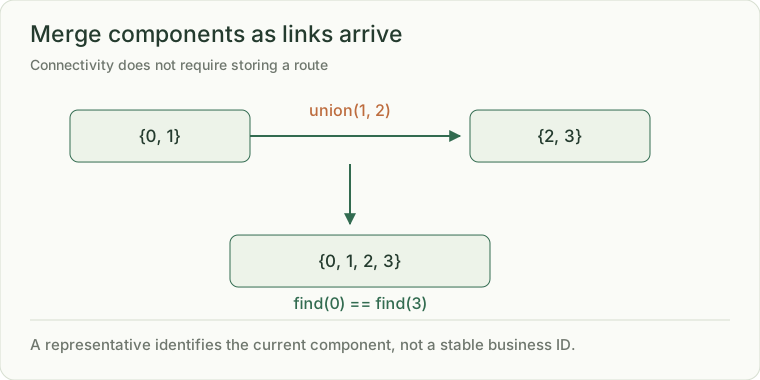
union(0, 1)merges{0}and{1}.union(2, 3)creates another component{2,3}.find(0) == find(3)is false.union(1, 2)joins both components, so the same comparison becomes true.- Repeating
union(0, 3)returns false: they are already connected.
With weighting and path compression, a sequence of operations is almost constant time per operation amortized, formally O(α(n)), with O(n) storage. The representative is an implementation choice, not a stable business identifier.
Union-find does not return the actual path between two vertices and does not support arbitrary edge deletion in this simple form. Use graph traversal for paths; reconsider the structure when removals enter the contract.
Source: Union-find API and bounds