Route extracted invoices through validation and review
Application background
A finance team uploads invoice documents and wants usable accounting records. An extraction service reads each document and proposes values such as supplier, invoice number, currency and total. A reviewer handles proposals that do not meet the acceptance rules.
A document can be readable but contain inconsistent totals. Separately, the extraction provider can be unavailable. Those situations require different next steps. A corrected document may also arrive with the same invoice number, so that number alone cannot identify the exact source.
Source data that needs human review
An illustrative extraction result says:
{"invoice_number":"17","currency":"USD","line_amounts_minor":[1000,250],"total_minor":1990}
The lines add to 1,250 cents, but the proposed total is 1,990 cents. That mismatch calls for a document review. A provider timeout, by contrast, supplies no such extracted fields and belongs in the separate provider-failure path.
Validation checks whether proposed fields satisfy the accounting rules. Source identity says which exact document those fields came from. Keep both separate from the business invoice number.
Your assignment
Deliver: Extend the supplied extraction workflow with document-version tracking and a review interface. Give invalid document content and provider failures different next actions.
Required behavior: Preserve source identity/version, extractor version and validated candidate fields. Review-required is a content outcome. Retryable failure is a transport/processing outcome. A corrected source gets a new version and cannot silently reuse an old accepted result.
The required first milestone is a working local implementation of the behavior above. The numbered implementation steps define the scope. The cloud architecture is a later extension, not something the starter has already provisioned.
Get the code and run the supplied example
The code is in the public junior-to-staff repository. Install Git and Python 3.12+. No AWS account or Python packages are required for this first run. If you already have a checkout, use it and skip cloning.
git clone https://github.com/Soulful-Iris/junior-to-staff.git
cd junior-to-staff
python3 examples/ai-systems/demo.py extraction
Supplied code: AI workflow implementation, starting at demo.py. These are local workflows with fixture providers and temporary storage. They do not include the user interface or connect to the AWS services in the diagram.
Example output from the supplied run:
Generated IDs and timestamps may differ. Compare the state transitions and outcomes.
[
  {
    "request": {
      "action": "invoice.extract",
… (more output follows)
Set up your implementation workspace
Create work/03-invoice-review/ in your checkout (or use a separate repository). Copy examples/ai-systems/ there so you can change the workflow and its storage/provider boundaries together. The record and module names below describe what you must implement. They are not a promise that files with those names already exist. Keep a README.md beside your implementation with its exact run commands and observed results.
Local components and state to implement
This table names the records, interfaces or decision inputs for your deliverable. Unless a name is explicitly linked to supplied source above, it is something you create. Implement the local state transitions first, then connect the HTTP, storage or worker boundaries required by the steps.
| Record / module | Key or interface | Responsibility |
|---|---|---|
| source_document | invoice_id,source_version,hash,object_key | Immutable evidence and corrected-source identity. |
| extraction_run | source_version,extractor_version,attempt | Candidate fields and processing outcome. |
| review_decision | revision,actor,confirmed_fields,reason | Human-approved data with provenance. |
Implement the assignment
1. Inspect the complete local workflow
Run the extraction demo and follow submission, extraction, validation, retry and review states. Use the retained code walkthrough to identify the source fingerprint and idempotency boundary before adding an OCR/model service.
2. Validate domain meaning
Check required fields, currency, dates and line-total arithmetic using explicit decimal/minor-unit rules. Keep raw suggestions and evidence locations. A schema-valid object can still contain the wrong total or vendor identity.
3. Separate retry from review
Retry transient timeouts under a bounded budget. Route ambiguous content, missing evidence and inconsistent totals to human review. Preserve the previous confirmed decision when a machine retry produces another suggestion.
4. Handle corrected source versions
A new source hash/version creates a new processing intent. Link it to the business invoice and prior review history, then require an explicit decision about superseding confirmed data. Reconciliation records explain which source version reached downstream accounting.
Demonstrate the completed local result
| Action | Expected visible result |
|---|---|
| Run the existing extraction demo | Inspect distinct review, retry and reconciliation outcomes. |
| Return valid JSON with inconsistent totals | The document goes to review rather than automatic acceptance. |
| Upload corrected source bytes | A new source version is processed and linked to prior evidence. |
Handoff: In your implementation README, include the start command, one successful operation, the failure case above and the resulting stored state or decision. State which dependencies are simulated. Someone with a fresh checkout should be able to reproduce this without your chat history.
Workload assumptions and capacity decisions
These are constructed exercise assumptions. The stated workload is a design target. The local demonstration does not establish that throughput. Use the estimation constants to check units before choosing capacity.
| Input or objective | Calculation / consequence |
|---|---|
| 1,000 invoices/day. 2 MB mean source assumption | About 2 GB/day of originals before versions and retention. |
| 5% content review rate | Fifty human reviews/day. Measure that queue separately from infrastructure retries. |
| Three bounded processing attempts | Exhaustion becomes visible repair work. Repeated extraction cannot make invalid arithmetic valid. |
Map the local implementation to AWS
Deployment status: local only. Running the supplied command creates no AWS resources and configures no cloud connections. The diagram is a proposed deployment of the completed application. Each box needs either a deployed runtime, a provisioned service or an explicitly external dependency.
Read the diagram by following the arrows from the entry point: application code accepts the request or event, the state owner commits it, and any worker produces the later result. The table ties those roles to code and adapter work. Multiple boxes do not imply multiple Python files already exist.
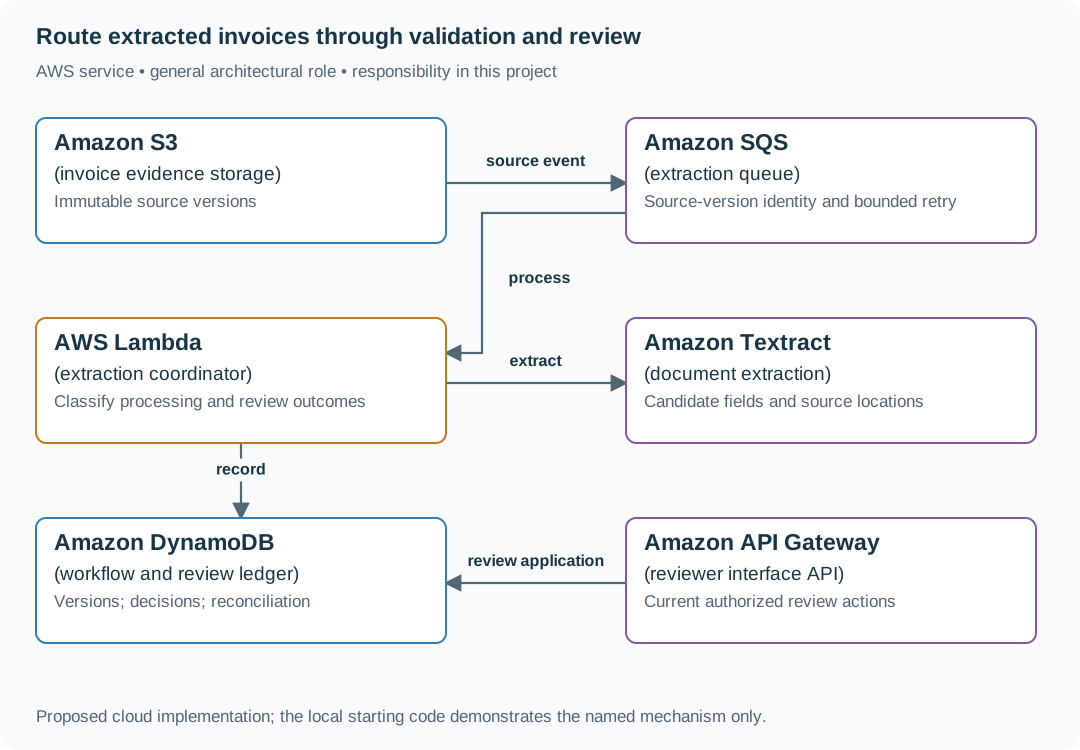
The extractor proposes fields. Deterministic validation and human review decide whether those fields are usable. Separate source versions prevent a retry from hiding a corrected invoice.
| Local responsibility | Cloud destination and role | Implementation still required |
|---|---|---|
| Local file, object fixture or exported payload | Amazon S3: invoice evidence storage | Implement upload/download and metadata adapters, scoped access, object naming, retention and incomplete-upload cleanup. |
| Local pending-work collection | Amazon SQS: extraction queue | Publish committed job intent, consume messages and persist deduplication/ownership state. Add visibility, retry and dead-letter handling. |
| Python operation or worker function | AWS Lambda: extraction coordinator | Write a Lambda event adapter, package its dependencies and give its role only the required resource actions. |
| Local extracted-field fixture | Amazon Textract: document extraction | Implement asynchronous or synchronous extraction adapters, retain source version and separate provider failures from invalid extracted data. |
| Local dictionary, SQLite records or state model | Amazon DynamoDB: workflow and review ledger | Design partition/sort keys and write a storage adapter with conditional updates or transactions. Python state and SQL are not uploaded as a database. |
| Local HTTP boundary or the endpoint you will add | Amazon API Gateway: reviewer interface API | Create routes and an integration. Translate requests and responses and configure identity validation. |
Provision resources, then connect the application
| Resource or boundary | Initial configuration and reason |
|---|---|
| Source storage | Private versioned originals, bounded file/page sizes and controlled retention. |
| Processing | Stable source-version key across retries. Explicit DLQ/repair state for exhausted infrastructure failures. |
| Review | Conditional revisions and actor evidence. Downstream publication uses confirmed version identity. |
Use one disposable AWS environment for the cloud exercise. Put the named resources in infra/template.yaml or your existing IaC tool, pass resource IDs through configuration, and scope each runtime role to its own tables, buckets and queues. The diagram is a design to implement. It is not a claim that these resources have been deployed. Record the commands you used to deploy and remove the exercise resources.
For concrete provisioning commands, configuration wiring and cleanup, use the AWS foundation guide. It includes a deployable table/queue/object-storage foundation and explains which application and service adapters you still implement.
A provisioned queue or table does not make the local program use it. Configure resource IDs in the deployed runtime, replace the local adapter, and replay the same successful and failing operation against that runtime. Record the deployed commit and observable result, then remove the disposable resources using your infrastructure tool.
Extend the design after the baseline works
Worked follow-up: Assemble a multi-file invoice before extraction
Page one may contain the supplier and subtotal while page two contains tax and the final total. Treating each upload as a complete invoice can publish partial or duplicate results.
| Starting design | Changed requirement |
|---|---|
| One immutable source document produces a versioned result. | One invoice arrives as several files, sometimes out of order. |
Revised architecture. Follow the changed responsibility and failure path below. This is a design to implement. The supplied local example does not provision these components.

What to implement. Create a bundle manifest with invoice identity, expected members, object hashes, version and closed state. Do not infer completeness merely from a quiet queue. A sender completion signal or an explicit operator decision closes the bundle. Derive extraction identity from the complete ordered manifest and extraction version. Corrected members create a new bundle version. Publish a reviewed result only if it still matches the current accepted source version.
Walk through the result. Upload page two first and show waiting for source completion. Upload page one, close bundle v1 and extract once. Replace page two with a corrected total to create v2, then replay v1. The old result remains historical and cannot replace v2. Deliver the manifest, completion rule and result-version timeline.
One invoice is split across several files. Define the complete source bundle identity and completion rule before extracting. A partial bundle must not be published as a final invoice.
Additional design cases, alternatives and original source notes
The reviewer's brief
“Operations receives invoices as text from an existing document parser. Extract the USD total and the evidence supporting it. Some invoices are ambiguous, some model calls fail, and our queue delivers the same message twice. Build a result the operator can inspect without silently accepting the wrong amount.”
End product: a working text-to-structured-data pipeline with model inference, independent field validation, source evidence, durable outcomes, duplicate detection, and an asynchronous AWS queue worker. It accepts text, not PDF images. Parsing and OCR are clearly identified extensions. The delivered pipeline starts with extracted text and ends with a saved, queryable result.
Establish the contract
The reference supports one standalone TOTAL marker per record, source text up
to 8,000 characters, and integer cents between 1 and 100,000. Its complete field
runs from TOTAL to a semicolon, line ending, or end of input. After trimming
trailing spaces/tabs, it must be TOTAL USD digits.two_digits: spaces/tabs
between words, one to six ASCII digits before the decimal, exactly two after.
An unsupported suffix is reviewed, not silently truncated. The model's claimed
confidence is not an acceptance criterion.
01 · Valid invoice
- Input / starting state
- ID
invoice-17, textACME invoice 17. TOTAL USD 12.50 - Expected result
ACCEPTED,currency: USD,total_cents: 1250, exact evidence
02 · Numeric suffix
- Input / starting state
TOTAL USD 12.345,12.34e2, or12.34.99- Expected result
REVIEW_REQUIRED. Never accept the12.34prefix
03 · Invalid second total
- Input / starting state
TOTAL USD 12.50; TOTAL unreadable- Expected result
REVIEW_REQUIRED. A malformed second marker is still ambiguous
04 · Redelivery
- Input / starting state
- Same ID and same source text
- Expected result
- Same saved result. No second model call after the result is committed
05 · Changed payload
- Input / starting state
- Same ID, text changed to
TOTAL USD 13.00 - Expected result
- Conflict. Do not overwrite the original record
06 · Missing currency
- Input / starting state
- Text
TOTAL 12.50 - Expected result
REVIEW_REQUIRED,data: null
07 · Two totals
- Input / starting state
- Text
TOTAL USD 12.50; TOTAL USD 14.00 - Expected result
REVIEW_REQUIRED. Choose neither automatically
08 · Fabricated evidence
- Input / starting state
- Model says
TOTAL USD 12.50, source contains onlyTOTAL USD 99.99 - Expected result
REVIEW_REQUIRED
09 · Subtotal confusion
- Input / starting state
- Source has
SUBTOTAL USD 12.50; TOTAL USD 14.00. Model selects the subtotal - Expected result
REVIEW_REQUIRED
10 · Provider failure
- Input / starting state
- Model request times out
- Expected result
- Do not save a terminal invoice result. Retry through SQS
11 · Mixed queue batch
- Input / starting state
- One valid JSON message and one malformed JSON message
- Expected result
- Return only the malformed message ID in
batchItemFailures
Learn the distinction between review and retry
Review means the pipeline ran and could not establish a safe data result. Repeating the same ambiguous input with the same model is not a recovery plan. Retry means a dependency failed before a useful terminal result was established. A dead-letter queue contains messages that repeatedly failed processing. It is not the same collection as invoices requiring business review.
Draw the AWS architecture
| AWS service / general role | Implemented responsibility | Alternative and deciding factor |
|---|---|---|
| Amazon SQS / work queue | Hold extraction requests and redeliver failed work | EventBridge for event routing. It does not replace record-level processing state |
| AWS Lambda / worker | Validate request, invoke model, validate result, and report failed message IDs | ECS/Fargate for larger parser dependencies or longer work |
| Amazon Bedrock / field extraction | Suggest currency, cents, and exact evidence through Converse | A deterministic parser is better for reliably structured invoices |
| Amazon DynamoDB / result and duplicate registry | Associate record ID with source hash and terminal outcome | Aurora for relational review workflows and reporting |
| Amazon S3 / result artifact storage | Preserve inspectable result content under a content-derived key | Existing document platform if it already owns artifacts and retention |
| Amazon SQS DLQ / failed-message inbox | Retain work that fails after three receives | A managed workflow when each processing stage needs separate recovery |
| Amazon Textract / OCR and document extraction | Extension, not part of the supplied text-input baseline | Existing parser if it already preserves reliable text and page references |
Implement the path from submission to result
- Assign a stable record ID. A producer retries with the same ID and unchanged source. Hash the source so an ID reused for different data becomes a conflict.
- Check the result registry first. If the record already has a terminal outcome with the same hash, return it. This avoids a new inference call on ordinary redelivery.
- Extract once per attempt. Request a JSON object. The model cannot write directly to DynamoDB or acknowledge the queue.
- Validate the complete source field.
invoice_fields.source_totalchecks the original text independently of the model-selected span. Require USD, bounded integer cents, one standalone total marker, and exact agreement with the complete validated evidence. A substring that stops before an extra decimal digit or exponent is not valid evidence. - Publish complete bytes before the pointer. On AWS, write the content-derived S3 object, then conditionally publish its pointer and status in DynamoDB. Locally, sync a same-filesystem temporary file, publish it without replacing an existing object, sync the directory, then commit the SQLite pointer. Existing bytes are verified, never reopened for truncation. Filesystem durability support is a local prerequisite.
- Acknowledge terminal outcomes. Both
ACCEPTEDandREVIEW_REQUIREDare successfully processed messages. Model/network failures propagate to the worker's partial-batch failure response. - Read by record ID. Operators query the result endpoint. They do not infer completion from the producer's successful
SendMessagecall.
The core retry decision is independent of model wording:
if existing:
    if existing["source_hash"] != source_hash:
        raise Conflict("record ID reused with different source")
    return existing
The complete invoice_extract implementation adds validation, artifact storage, and a conditional create. Two simultaneous first attempts can both call the model. Only one result wins publication. This provides one committed result, not a guarantee of one billed inference call.
| Interrupted step | What a reader can observe |
|---|---|
| Before object publication | No new result. Existing committed results remain intact |
| After object publication, before registry commit | Complete unreferenced object. Not a published result |
| Duplicate write after a result is committed | The same intact object and saved result. No truncating reopen |
Worker logs contain a hashed message reference, a bounded category and retry
decision, not invoice text, exception text or model output. ACCEPTED and
REVIEW_REQUIRED are acknowledged. Provider/storage failure, malformed messages
and changed-ID conflicts are reported for retry/redrive. A permanent producer
error needs correction before redrive, not an infinite retry loop.
Run the complete local session
python3.12 examples/ai-systems/demo.py extraction
The session extracts invoice 17, repeats it, quarantines invoice 18's unreadable total, and reads the saved result. Compare the repeated result's artifact key and source hash. The test suite injects ambiguous totals, missing currency, fabricated evidence, duplicate IDs, and provider failure.
For AWS, first use cloud_smoke.py extraction --function "$AI_FUNCTION" to exercise the synchronous handler. Then follow the workbench's SQS submission instructions to exercise the actual asynchronous worker. An immediate lookup may return NOT_FOUND. Successful queue submission means accepted work, not completed extraction.
Follow-up: a replay contains corrected source data
The business corrects invoice 17 after its first result was accepted. Reusing its ID with different text must conflict. Otherwise a duplicate-delivery mechanism becomes an accidental edit API.
Senior follow-up: introduce explicit document version and extraction version in the operation identity. A corrected document creates a new result and preserves the prior artifact. Add a review action that records who accepted a correction, which source version it uses, and why.
Staff follow-up: process millions of documents. Compare managed Bedrock batch inference against per-message inference. Batch output must be reconciled by record ID, with per-record errors and missing records accounted for. Do not assume output order equals input order. Partition tenants, control spend and queue age, and design a backfill that cannot replace newer accepted data.
Engineer FAQs
Why use an LLM for such a regular sample? The fixture deliberately has a deterministic oracle. For this exact format, a parser is cheaper and sufficient. The AI integration becomes useful only when a real corpus contains enough variation to justify it. Compare against that parser before adopting it.
Does valid JSON mean the invoice is correct? No. A perfectly shaped result can select a subtotal, invent currency, or attach unrelated evidence. Field validation and semantic evidence checks are separate from JSON parsing.
Can the model's confidence decide automatic acceptance? Treat it as a feature to calibrate against human labels, not an authority. The reference accepts only its narrow independently checked contract.
Why not retry review cases forever? More attempts may increase cost without adding evidence. Change the source, parser, model version, or reviewer input under an explicit new operation identity.
Can a queue guarantee exactly one extraction? No. Delivery and processing can repeat. The registry prevents multiple committed outcomes. Inference can still repeat if a worker fails before publishing its result.
Why is the visibility timeout much longer than Lambda's timeout? A message must remain hidden while work and invocation retries occur. The template uses 1,080 seconds against 180 seconds of function time. Tune queue age, retry delay, and timeout together from observed duration.
How do we recover DLQ messages? Inspect the failure, fix its cause, and redrive with unchanged record identity. A permanently malformed message needs producer correction, not an endless redrive loop. Inspect the stored result first because a prior attempt may already have committed.
Where is the PDF interface? Outside this project's declared boundary. An OCR extension must preserve page coordinates and source versions, handle password-protected or corrupt files, and validate parser output before it reaches the model.
What you are expected to hand over
Bring a saved accepted result, a review result, a duplicate-delivery trace, a partial-batch failure response, and an asynchronous AWS run when you have deployed the stack. Explain the source of truth, orphan artifact behavior, inference retry cost, and DLQ recovery.
How the review conversation gets harder
| Review gate | Changed requirement | Evidence to bring |
|---|---|---|
| Baseline | Extract USD 12.50 | 1,250 cents and exact source evidence |
| Failure | Currency is missing | Review status with no invented value |
| Senior | A worker dies after inference | Safe replay and one committed result |
| Staff | Reprocess millions of corrected documents | Versioned identities, reconciliation, tenant and spend controls |
| Evidence | One message in a batch is malformed | Only that message is marked failed |
| Handoff | Queue stops draining | Queue-age diagnosis, DLQ inspection and safe redrive procedure |
Research behind the design
Reviewed September 23, 2026. AWS documents Lambda/SQS retries and partial-batch responses, Bedrock structured outputs, batch input identities, and per-record batch outputs and errors. Managed batch inference is an extension. The AWS reference is configured for SQS plus Converse calls. No live deployment is implied by the local tests. Its narrow invoice validator is original teaching code.