Observe Inc. · senior backend / product engineering
Your worked rehearsal: join late telemetry and show whether results are complete
An engineer opens a trace and expects to see related log events. Those events can arrive late, be repeated, or share a trace ID with data from another tenant. A join result therefore needs both an access boundary and an explicit completeness policy.
Implement the event-time join for the stated ten-second window, then explain bounded lateness, overload, and deletion of derived results. The model is an original practice service. It is not a description of Observe’s internal implementation.
Starting point: these drills are build briefs. Implement in a local file or draw the requested architecture. The worked answer is an explanation, not a supplied end-to-end application. Choose one drill per session, then change one requirement after the baseline works.
Observe describes a product that correlates logs, metrics, and traces with context, ingestion, and investigation workflows. We did not find a reliable, recent senior SWE candidate report giving a stable interview loop. Everything below is an original simulation grounded in the public product domain; none is a claimed Observe interview question. Ask the recruiter for the actual round structure.
The room · the answer must survive noisy data
Practice pressure: telemetry arrives late, duplicates, lacks identifiers, and spikes when systems fail. A pretty dashboard is only useful if it preserves the provenance and uncertainty of its answer. Set an acceptable latency, retention, and cardinality budget before proposing boxes. This is a rehearsal frame, not a candidate-experience claim.
Ask first: Which signals share a trace ID? Do we have event time or ingestion time? What happens to a join after its window expires? Which tenant can query which fields? What is the query-cost ceiling?
Choose a coding exercise · eight original drills
| Drill and exact ask | Example to settle before coding | Senior stretch |
|---|---|---|
01 · Join log and trace events by (tenant,trace_id) within 10s event-time window |
log at 9, trace at 12 → match | Out-of-order arrivals and watermark; mock below |
| 02 · Rolling p95 on the last 5 minutes | latencies [10,20,30,40,100] → 100 with nearest-rank rule |
Approximation and mergeability |
| 03 · Bounded ingest buffer | capacity 2; third event → explicit backpressure | Spill, loss semantics, fairness |
| 04 · Per-tenant cardinality guard | keys a,b,a, cap 2 → accept all; c → reject |
Noisy labels and top-k fallback |
| 05 · Parse structured log line with escaped delimiter | a\|b|200 → two fields |
Malformed records and size limits |
| 06 · Prefix index for service names | query pay → sorted pay-api,pay-worker |
Updates and memory |
| 07 · Dedupe at-least-once telemetry | event-id=7 twice → one aggregate increment |
Expiring keys and late replays |
| 08 · Alert state machine with 2/3 bad windows | bad,good,bad → firing |
Recovery hysteresis and missing data |
Choose an architecture exercise · five original prompts
| Prompt | Initial requirement | Change the requirement |
|---|---|---|
| Telemetry ingestion | Accept logs and traces | Outage burst and backpressure |
| Trace-log correlation | Click from trace to matching logs | Missing IDs and late data |
| Alert evaluation | Notify on sustained p99 rise | Quiet hours, dedupe, missing data |
| Multi-tenant investigation | Query one team's telemetry | Cost guardrails and fine-grained field access |
| Retention and archive | Keep hot data for 7 days | Legal deletion and cold replay |
Worked session · correlation with a closing window
Interviewer: “A trace span and a log line can arrive in either order. Join them by tenant and trace ID if their event times are within 10 seconds. How will a user know the result is complete?”
Clarify aloud: Distinguish event time from arrival time. Assume (tenant, trace_id, event_id) unique, absolute timestamp difference ≤10s, duplicates ignored, and 30s tolerated lateness. Events after the watermark are retained in a separate late-data path, not silently inserted into already-finalized counts.
| Events | Expected | Edge |
|---|---|---|
log t=10, span t=12, same tenant/trace |
One pair | Baseline |
| span arrives before log | Same one pair | Arrival order |
| same trace ID in another tenant | No pair | Isolation boundary |
log t=10, span t=21 |
No pair | Window boundary |
log t=10, span t=20 |
One pair | Inclusive 10s boundary |
| same log delivered twice | One pair | Duplicate delivery |
| matching log arrives after watermark | Late-data counter/reconciliation | Completeness is conditional |
Think in public: index unmatched entries by (tenant, trace_id) and event time; on receipt, probe opposite type in [t−10,t+10], emit idempotent pair IDs, then evict only when the watermark proves a match cannot still arrive under the assumed lateness bound. Complexity O(log n + matches) per event with a time index, memory proportional to open windows and cardinality. Publish “provisional” versus “finalized” status to users.

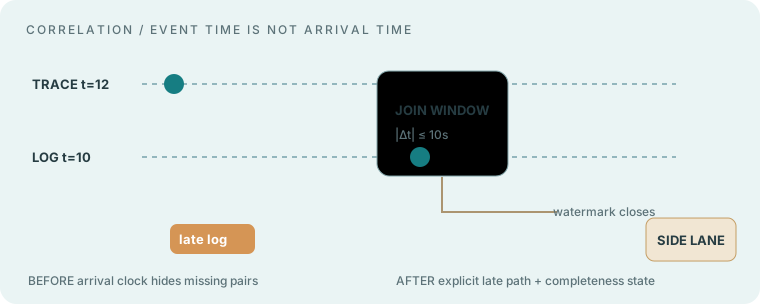
Before / after: the animation shows why a late log cannot be treated as if the arrival clock were the event clock. Redraw the diagram with the watermark and side stream before adding a dashboard.

Follow-up 1 (senior): “A bad deploy increases events 50×.” Bound state per tenant, partition by tenant/trace, signal partial results, shed or spool according to loss contract, and measure watermark lag. Follow-up 2 (staff): “A customer deletes a trace while cold storage and derived joins retain it.” Trace lineage across raw, derived, index, cache, and archive; specify deletion propagation, audits, tenant-specific encryption or retention, and an observable completion SLO.
Worked extension: make late reconciliation and deletion explicit
A watermark is a progress estimate under an assumed lateness policy. It does not make late events impossible. Route events arriving after finalization to a visible late-data path. If reconciliation can revise a result, publish a new version and define whether the UI shows provisional, finalized, or revised evidence.

When deleting a trace, include derived pair IDs, indexes, cached query results, and retained archives in the deletion plan. Mark completion only when the declared scope is satisfied. A raw-event deletion alone does not remove an already materialized join. During a 50× burst, enforce a tenant state budget and report partial evidence according to the loss policy instead of silently returning incomplete results as complete.
Debrief · what a strong answer contains
Never confuse missing telemetry with healthy service. Give a correctness contract for duplicates and lateness, a memory/cardinality budget, a visible completeness state, and a reproducible investigation path. The architecture is a practice design, not a claim about Observe's actual internals.
Evidence: Observe's official product overview is domain context only. No verified recent senior candidate loop was found as of 22 September 2026; verify role and format directly.