Assessor · event consumer
Give only the candidate brief. This is a constructed pack. Release one change at a time; do not diagnose its implementation for the candidate.
| Time | Held-back change / exact fixture | Expected reasoning and output |
|---|---|---|
| 15 min | Preserve one consumer across two calls: first [(r1,book,+5),(r2,book,-3)]; then [(r2,book,-3),(r3,book,+4)]. Return a snapshot after each call. |
Totals 2 then 6; retain dedup state across calls, and keep the first returned snapshot at 2 rather than aliasing mutable totals |
| 30 min | Same ID can conflict: (r1,book,5),(r1,pen,5) |
Explicit conflict error; do not silently dedup by ID or overwrite old meaning |
| 35 min | A batch contains valid r3 followed by conflicting r1; batch must be atomic | Validate/plan complete batch before changing state, or rollback; no partial r3 effect |
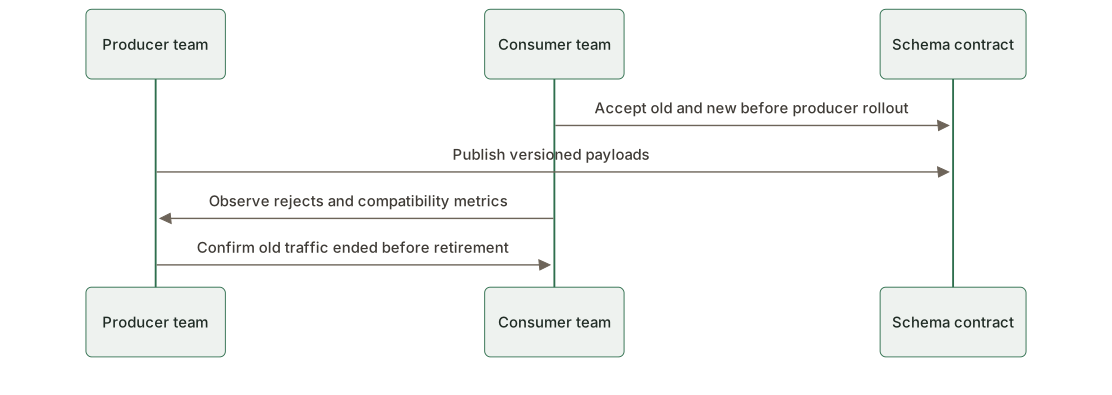
| Lead | Old producer omits a new schema field; two teams deploy independently | Define schema/version compatibility, owner for rejection/quarantine, rollout and retirement checks |

| Dimension | Weak: 0–1 | Adequate: 2 | Strong: 3 |
|---|---|---|---|
| Correctness | Drops only adjacent duplicate; accepts conflicting ID | Retains identities across calls, returns stable snapshots, and detects conflicts | Proves batch atomicity with late-conflict regression |
| Implementation | Pseudocode only or cannot run | Runnable tests for empty, invalid, repeated IDs | Adapts without breaking baseline and compares against a tiny oracle |
| Reasoning | Names hash map without its invariant | Maps event ID to normalized payload; totals reflect accepted unique effects | Accounts for retained IDs and limits of bounded-memory exact dedup |
| Lead ownership | “Tell other team to fix it” | Names schema owner and compatibility contract | Sequences producer/consumer rollout, monitoring, stop condition and old-version retirement |
Failing approaches: summing then deduplicating output; keeping only last ID; silently discarding every ID collision; mutating half a batch before discovering a conflict. Each has a supplied fixture above. A stronger candidate may choose immutable staged state over rollback; score the invariant and complexity, not a preferred implementation.
Debrief: identity maps, importer replay and conflicts, rubric. On the second occasion, switch to reservation IDs with explicit release events; recognition of this exact prompt is not transfer evidence.